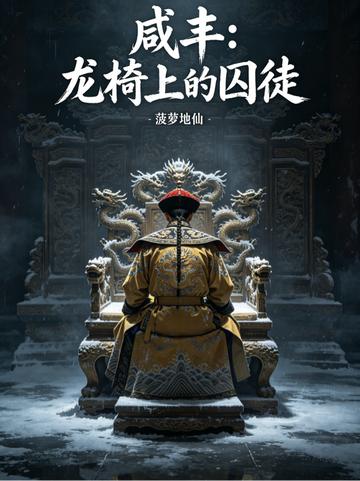
The dragon throne is the loneliest instrument of torture in the realm.
He took his seat at nineteen and died coughing blood at thirty-one.
For twelve years, he gave his life to sing a requiem for a great empire that no one could hear.
He treated being emperor as a punishment.
At nineteen, Aisin Gioro Yizhu took his seat on the dragon throne in the Forbidden City. He thought he held supreme power, unaware that he had become the foremost prisoner in the most splendid cage in the realm.
Beneath his court robes was a frail body coughing blood under the weight of memorials;
Beside the imperial seal, fires were being lit by the “rebels” in Guangxi and the “foreign barbarians” from Britain and France;
Below the vermilion steps stood a court full of officials who spoke of loyalty while pursuing factional interests and attacking their rivals.
He had once hoped to become a wise ruler who would restore the dynasty, only to discover that all he could do was make one desperate choice after another between “wrong” and “even more wrong.”
He had once hoped to save a kingdom on the brink of collapse, but could only watch as the flames engulfing Yuanmingyuan lit up the distant night sky while he fled in panic on his “northern tour.”
On his sickbed at the Rehe Imperial Retreat, surrounded by the smell of medicine and wine, he finally understood:
He had not been defeated by Hong Xiuquan or by foreign guns and cannons. He had been defeated by a collapsing age, by the inescapable fate that came with sitting on the dragon throne.
This is an 800,000-word psychological record, a complete demystification of the word “emperor.”
Through the gaps in the historical record, we witness his entire journey from determined reformer to spiritual fugitive, and see how a living man, wrapped in imperial robes, burns away to become the empire’s most tragic sacrifice.

The writing is super good, the various scenes, and the psychological changes of the characters are super delicate. When I read it, the scene immediately came to my mind. Good luck to the author.