In 259 BCE, a boy was born in Handan, in the state of Zhao. There were no auspicious clouds or red light, only a night when his father abandoned him and an alley where children his own age chased him down and beat him.
His name was Zhao Zheng.
It took him ten years to go from an abandoned child in Handan to the throne in the Xianyang Palace. From the fall of Han to the unification of the Six States took another ten. He melted all the weapons in the land into bronze statues, unified all the written characters into small seal script, and built highways across the realm. Standing alone atop Mount Tai to offer sacrifices to Heaven, he needed no one to teach him how to speak to it.
But he could not stop his body from slowly rotting at Shaqiu. Three years after his death, the empire fell. Four years after his death, Xiang Yu burned the Xianyang Palace to ashes.
Then Liu Bang rose from those ashes, took the laws, script, weights and measures, and commandery-and-county system Zhao Zheng had left behind, and gave them a new dynastic name. The Han inherited the Qin system. The man died, but the rules he established lived on for two thousand years.
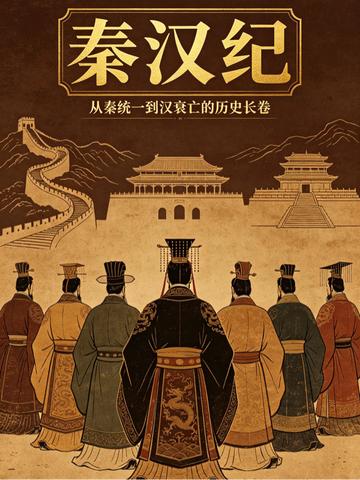
From Qin Shi Huang’s unification of the realm, through the bloody Chu-Han Contention, the recovery and prosperity of the Wen and Jing reigns, Emperor Wu of Han’s golden age and campaigns against the Xiongnu in the north, Wang Mang’s usurpation and the realm’s division, Guangwu’s restoration and the rebuilding of Luoyang, to the collapse of the Eastern Han: this book recounts the entire rise and fall of China’s first unified empire. It takes an even-handed view of emperors and tells its story in the voice of a storyteller who blends narration with commentary. This is no family tree of emperors and ministers, but a portrait of people confronting power, betrayal, loneliness, and death, and the choices they made about how to live and how to die.
From Zhao Zheng to Liu Bang, from Xiang Yu to Han Xin, from Wei Qing to Huo Qubing, from Wang Mang to Liu Xiu: their blood still flows through our veins.