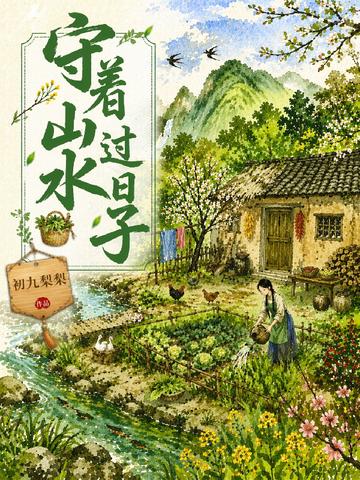
After transmigrating, Shen Qinghe becomes the second daughter of the Shen family in Qingshui Village.
Her family has four mu of poor farmland, an almost empty grain jar, and a drafty house. When the spring famine arrives, even wild greens have to be gathered early before they're all gone.
She has no pocket dimension, no System, and no influential benefactor to help her. All Shen Qinghe can rely on are her own two hands.
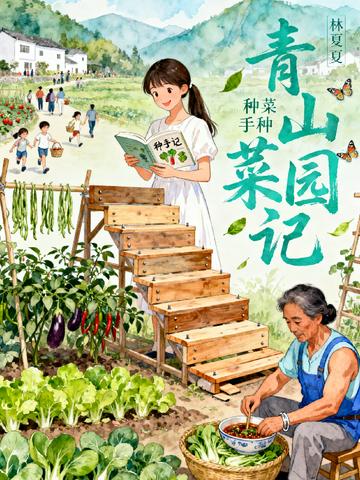
She gathers wild greens at the foot of the mountain, finds snails by the stream, picks mushrooms after the rain, grows vegetables in the yard, and cooks hot meals in the kitchen.
Starting with putting food on the table, she gradually saves dried vegetables and grain, raises chickens and ducks, and repairs the house, slowly bringing warmth to a life that once felt painfully empty.
No awful relatives, no princes or young nobles, no hidden identities. Just farming and everyday life.

It's been a long time since I've seen such a down-to-earth real farming article. There are no brainless people, gossips, bad luck, landlords and officials. There is just the whole family working together, saving money bit by bit to make life better and better. It's all about hard work, no shortcuts! The days are passing by, the children are growing up slowly, and the anger of the people watching has become much less. My family, I am at peace! The author is a young lady. I know she must be a young lady. Please continue to update. I want to see them live slowly, grow old slowly, and live peacefully in the years. I always feel that this article is almost something, and when I think about it, it almost feels like a human being. The whole family is like NPC, without emotions and psychological activities. They repeat almost the same dialogues and daily routines. Some articles describe a lot of psychological activities, but this one does not have it at all. I get it, this is one of the many Al articles recently.
It was the first time I saw the poor and lazy protagonist's family. There were many poor children in the family. They didn't even have a vegetable patch. They dazzled after picking wild vegetables. They had rice to cook porridge. They didn't know how to live without rice. Before the heroine arrived, the whole family went to touch snails and plant some vegetables. The whole family was busy together. There was no division of labor. Just changing the water for the snails. The elder brother washed in the morning and the mother changed the water in the afternoon. They all seemed busy, but in fact they didn't know what they were doing. Everyone was surrounding the heroine. The heroine pushed and walked around. She said that there was not enough grain. She actually planted the grain in the field without planting seedlings. She was really not afraid of waste.
The atmosphere in the heroine's family is very dull. The heroine's father and eldest brother are not very present. The heroine's mother is described as a person who talks too much and ruins the atmosphere. The atmosphere is a little more relaxed. When someone speaks, the heroine's mother chokes the person back first. (Maybe I am more sensitive, but I don't mind this because I don't like to write the heroine of a family as someone who ruins the atmosphere, as if she is a very bad person.) And then there is something very strange. Before the heroine passes through, the heroine's parents are in charge. Logically speaking, they should know everything. Then after the heroine passes through, there is no transition and the heroine is directly in charge. Although this is not stated clearly, it is written in the subsequent description that when the heroine speaks, her parents and family will do something. It is a very common and ordinary thing, and the heroine is asked to do it. She taught her family step by step how to do it, and then her family understood how to do it. Just like washing wild vegetables, the heroine asked her to tell her how to wash the wild vegetables, so that her mother knew how to wash the wild vegetables. When the heroine was cooking, she had to teach her mother how to cook the vegetables so that they would not be so bitter. Only then did her mother know that cooking the wild vegetables would not be so bitter. This is what makes me feel very strange.
There is no messy plot in this farming novel. There is no bad luck or golden fingers. The heroine and her family work hard for life seriously. It is a simple and flavorful farming novel.
The author still lacks common sense in some aspects, and his writing is average. For example, who goes to touch the snail lion in the early morning at dawn? The sun is out. Wouldn't it be better to go when the water is warmer? Going into the water early in the morning is not a waste of time until the baby is born. Also, it was as if everyone was notified in advance when going to touch snails. So many families went looking for snails in the early morning of the same day.
Children talk so much
Hey, I really can't understand why the heroine and her family always tell others how they make money and how much they sell for, instead of hiding it for fear that others won't imitate it. This is a way to survive, not to mention it's still that era! Can human nature stand the test? Give up, I'm so stupid!
It's hard to write, but why do you think ancient farmers dared to make so many snacks? I remember that there was a story that made people feel really real. The protagonist went to compost rotten leaves and other things with a very poor family. Only once, a neighbor smelled the smell and knew it was good fertilizer. Then he reported it to the landlord, and the housekeeper came to snatch it away. . .
The family couldn't say a few words, and it was deserted. The content was that they were thriving and getting better every day, but there was almost no warm and friendly atmosphere.
There are many repetitive plots, such as describing the prices in the town, and repeated visits to places and things to show, especially the younger brothers and sisters at home who ask about it every day, and ask if they can pinch it after the vegetables come out. They also ask about the wealth not being exposed. Are you really not afraid of people in the village doing evil? When people ask you, just tell them how much the food sold for. The second seller also said it. It looks a bit like AI (it's just my personal feeling, everyone feels different). Anyway, it's very bland and keeps repeating.