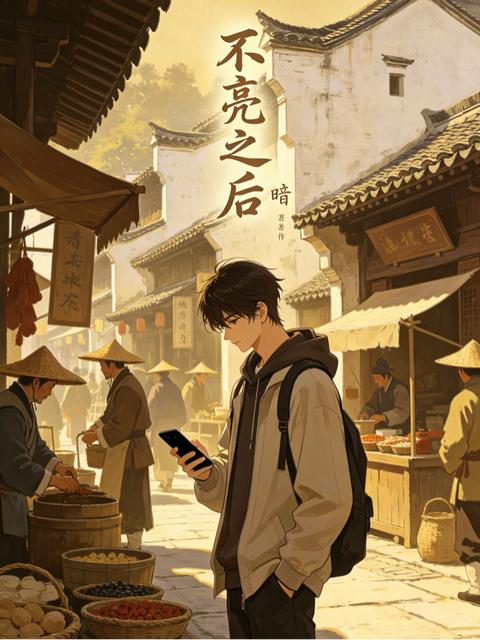
He arrives in the fifteenth year of Chongzhen with a head full of modern knowledge, a phone battery at thirty-seven percent, no network, and no backup. All he has is a piece of rock candy sweet enough to leave him stunned.
In Jinling, he meets three people. Shen Qizhang, a blood-coughing scholar from Songjiang, pries up the floorboards of the prefectural academy's granary and finds black mud and white mold dating back to the seventeenth year of Wanli. Zhou Susu, a woman from an old courtyard by the Qinhuai River, cuts sweet potatoes into pieces and stitches notes onto cloth, one by one: a waterwheel tilted half an inch, a water pump angled at twenty degrees. Wang Wensheng, a book carver, engraves plows, waterwheels, threshing machines, and granaries onto pearwood blocks, piece by piece. When he reaches the steam engine, he stops carving and inscribes two words: Wait for the right time.
They are waiting. Waiting for fewer military ships to crowd the canal, so coal ships can get a place in line. Waiting for the copper shaft forged by Yangzhou's coppersmiths to reach Jinling. Waiting for the black mud to be dug out, the lime to be laid, and the moisture barrier to dry. Waiting for someone to ask why water flows downhill, and for someone to know the answer.
Shen Qizhang's letters arrive one by one from Songjiang, Suzhou, Jiaxing, Huzhou, Hangzhou, Shaoxing, and Ningbo, their edges stained with soil from each place. Before Zhou Susu marries into a family in Yangzhou, she stitches one final line onto blue cloth: Water still flows downhill, but some of it now flows into the fields. Beneath the line, she stitches the two characters of the name Xu Che.
The phone's battery drops from thirty-seven percent to twelve. Some things light up, then go dark again. Even after they fade, people remember. What they remember is stitched into cloth, carved onto blocks, written in letters, and laid beneath the granary floor. When the light finally comes one day, it will still be there.