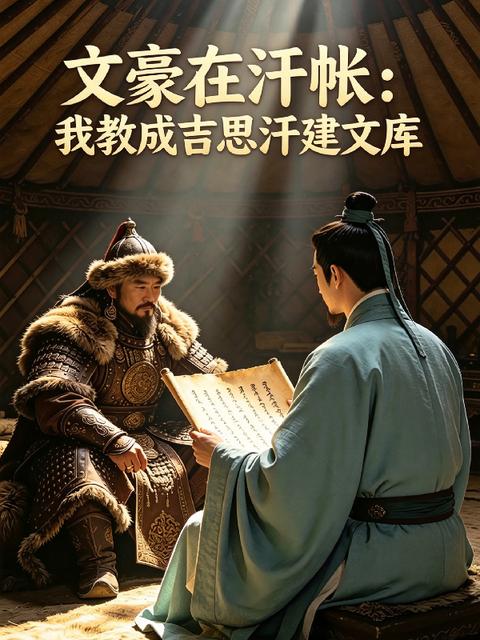
Lin Yuanzhou, a Peking University PhD in Mongol-Yuan history, woke to find himself a Naiman captive beneath Genghis Khan's blade.
At the execution ground, he sang an ancestral hymn from The Secret History of the Mongols in impeccable classical Mongolian, stunning everyone. The executioner's curved saber stopped in midair. Temujin sent a personal guard galloping off with an order: “Spare him.”
From then on, this scholar, weak as a kitten, became the grassland overlord's “cultural mentor.”
He created Mongolian script, letting decrees spread across the grasslands overnight;
He established the Great Yassa, making noyan and commoner alike subject to the same law;
He drew the Complete Map of the World, giving the Mongol cavalry eyes to survey the globe;
He built a library at the Khan's court, preserving the sparks of civilization amid the flames of war.
When Temujin proclaimed himself “Genghis Khan” at the source of the Onon River, Lin Yuanzhou stood behind him and read the sacrificial proclamation in both Chinese and Mongolian. The army prostrated itself, and the mountains rang with cries of “Great Khan!”
At that moment, he suddenly understood:
He had transmigrated across a thousand years not to witness history,
but to write it with his own hands.


At the beginning, there was one thing I didn't understand: wasn't it said that the protagonist had just created a new writing system? Why did his writing system become recognized by everyone in the country within two or three days, as if he didn't need to learn it and that a language-sharing magic had been cast on it? Seeking answers, waiting online.
This is the first novel I've read that's related to the Yuan Dynasty.
Five stars for it. However, it still has quite a few shortcomings. The biggest drawback is that the protagonist interacts too little with the world. Both the text and the map are carried over from the previous life, resulting in a lack of immersion. Furthermore, the relationship between the protagonist and the Mongol tribe cannot be purely cooperative; otherwise, the plot would feel somewhat thin.
As someone who reads and explores all genres, I've rarely, if ever, been so deeply moved by a novel. Walking down the street, when I saw the phrase "Eternal Heaven Power," I got goosebumps. There weren't any elaborate or lengthy descriptions, yet it transported me to the desolate yet not barbaric landscape of the nascent power of the grasslands. (More to come, more to read, more to enjoy!)
I deducted one star because, so far (from the dozen or so chapters I've read), it might indeed be a bit monotonous, giving off a somewhat indescribable feeling. But I'll still keep watching. (Perhaps it's due to the way Mongolian poetry is expressed. Maybe things will improve when they move south to the Song Dynasty?)
Many writers who write about the Yuan and late Ming dynasties focus only on the grand scale of national collapse and personal destruction, forgetting that this was also the birth of a nation—yes, not just a rise, but a birth... The author is writing about this very birth.
In fact, there are many parts that aren't very good, but why give it 5 points? Because it's meticulously written, respecting historical facts and maintaining the original historical timeline. To write a novel like this, it's safe to say, is among the top-tier novels in China, no, and even worldwide.
Art originates from life, life forms history, and history is a story. Some people write stories, and some people write history.
Appraisal complete. A masterpiece! The author's historical knowledge is solid, like a professor's, and the writing is excellent. Sooner or later, they will become a rising star in the history section.
The style has a bit of an AI feel, but it feels like it contains the author's own creative input.