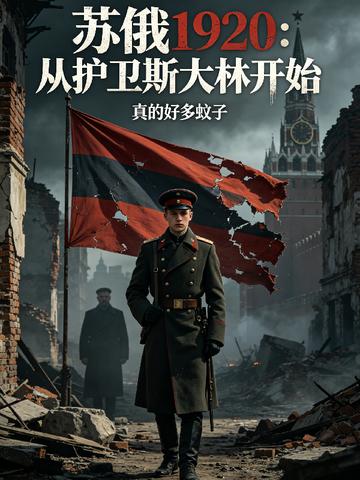
Soviet Russia, 1920: Starting as Stalin's Bodyguard
苏俄1920:从护卫斯大林开始
- Status
- Ongoing
- Length
- 2.5M Words
- Genre
- Urban
- Subgenre
- Urban Everyday
- Updated
- 3d ago
- Source
- Fanqie
Synopsis
Other names
- 从斯大林亲卫到最高掌权者Alternate title on Fanqie
More by this author
 Soviet Russia, 1920: Starting with the Cheka
 Doomsday Descends: My Teammates Come from One Piece and Naruto
 The New Qin Empire: From 1910 to the Top of the World
 Soviet Russia, 1945: A Game of Power
 Soviet Russia, 1920: From the Cheka to the KGB
 Germany, 1919: I Build a People's Republic
 The Red Three Kingdoms: I Found a Nation on the People
 The Red Tide: From Private to Man at the Helm
 Doomsday Commander: From Campus to Ruler of All
 I Tell Jokes at Crime Scenes to Scare the Killer
 Soviet Russia, 1920: Starting as a Kremlin Guard
In booklists 17
Founding a Country Overseas and Developing Technology
Looking for books similar to "World War: The Empire Rises, and the Great Powers Tremble".
War! War! War! World War II, the Cold War, or Modern Warfare. No Space Wars
Looking for Recommendations About the War of Resistance, or the Years After
Things like Hello, Japanese Soldiers, We're Gamers; Sea of Stars 1927; Transmigrated to 1937 and Bound to the Villain System, Now What?; The Fourth Disaster Begins with Millennium Dawn; 1949: A Telegram from the Northern Song Dynasty, and so on
Any Books About World War I or II? Europe, Germany, France, Britain, Italy, America, Austria, Russia, Hungary, Greece, Romania, and the Balkans
Looking for books similar to "Serbia's Counterattack".
Stories About the Protagonist Thriving Abroad
Any Novels About Founding a Country Abroad During World War I or World War II?
A Masterpiece About Nazi Germany in World War II
I want content similar to "Reborn in Germany: From Police Officer to Kingpin." Give me all the acclaimed masterpieces about World War I and World War II that you have!
Looking for Strategic-Scale Warfare and All-Out Clashes
There are way too many novels on Tomato where the protagonist is a sneaky schemer. I like protagonists who fight head-on. Are there any like that? A score of 9 is fine. Please recommend some, thanks!
Looking for Workplace or Political Career Novels
Looking for recommendations similar to You Call This a Workplace Rookie? or The Official's Path.
Novels About Founding a Country Overseas
Looking for a novel about founding a country overseas.
Looking for World War II Novels About Transmigrating to the Battlefield and Fighting in the Pacific or European Theater
Any Stories About European Politics and Wars? No Magic or Fantasy, Preferably Historical
Looking for books similar to "Welcome to 19th-Century Europe, Where Strength Reigns Supreme".
Protagonists with Unshakable Faith, Strong Will, and a Sense of Justice
The protagonist should have strong faith and conviction, and stand up for what's right. The supporting cast and villains shouldn't be idiots. I'm tired of cookie-cutter, mindless wish-fulfillment stories. I want something that fills you with faith and spirit, a true source of spiritual nourishment.
World War II Nation-Building Stories
A nation-building farming and conquest story set in the early 19th century, starting with a small faction and growing from there.
Any Books About World War II?
No harem stories. Preferably set on the European battlefield.
World War II Stories with a German Protagonist, or One from the Soviet Union
Stories About Rising to Power in Europe, the Soviet Union, Italy, and the American West
I'm looking for books like Reborn in Britain: From Gangster to Tycoon (Starting in Britain). Stories about a protagonist who rises step by step in Europe, the Soviet Union, Italy, and the American West. Somewhere between the criminal underworld and legitimate business, preferably set around World War I or II. The American West can be set in the...
Reader comments 64
Translated by Google Translate
I saw Chapter 25. The subject matter is great and the writing is okay. The description of language and style is not very good. You have to use Soviet thoughts and language to describe, and don't use too much Chinese thinking and tone. It is difficult to substitute and it is very dramatic. I think the author should search a lot of information and read previous novels about the Soviet Union. Learn from it. I hope to write better.
I have read more than fifty chapters so far, and the overall content is very well written. The protagonist's setting is very unique. He is of mixed Chinese descent, but uses a Russian-style name, and the character design has a strong sense of substitution. The plot begins with the protagonist signing up to join the Cheka and receiving rigorous training. He grows up step by step, and then enters the Kremlin and is assigned to serve as Stalin's bodyguard. The plot progresses layer by layer, the rhythm is very well controlled, and there are also famous highlights: on the first mission, he desperately protects the leader and saves Stalin's life. The plot is full of tension. The emotional lines of the characters are naturally unobtrusive. Under the arrangement of Stalin, he gets along with his best friend's daughter, and his daily life is warm and reasonable. The overall writing style is solid, the plot logic is online, and the historical background is restored in place. It is very enjoyable to read. I sincerely recommend it and give it a five-star rating!
Summary: So far I like this novel very much. Let's start with the short part of this article and end with the long part of this article. Short: The beginning of this article is a bit boring and lacks tension. The motivations of many characters are full of excessive idealistic rhetoric and are slightly optimistic about the description of human nature. The Soviet-Finnish Winter War not only describes the grand narrative of the "justifiable reasons" for the Russian-style security pretext to invade other countries, but also describes the conscience condemnation of many people, including the protagonist, and also describes the determination of the Finns to resist. The descriptions of these three points are very good and three-dimensional, but at the same time they are extremely unified to the protagonist and the protagonist's colleagues. It seems far-fetched: in the real world, there are such strong views of good and evil, and people who can sympathize with the suffering of the people of the enemy country and people who can resolutely execute the order of aggression cannot be the same kind of people. Power can change people, and decision-makers who can make cold-blooded decisions are without exception either born with cold-bloodedness or acquired cold-bloodedness. This kind of narrative is intended to create a willed superman who is free from schizophrenia. The sentence "I know it is sinful but I don't regret it" cannot bridge this logical gap at all. In addition, the progress of the novel is quite fast. The two decades from the 1920s to the 1940s have passed by in vain, and the family life has even changed directly from happiness to the betrayal of the wife and son. (It is understood that the author wants to create a reflection of Stalin's family tragedy in order to show the tragic hero's sense of fate that cannot take care of himself, but the lack of foreshadowing is too unconvincing.) Whether it is struggle, farming, or interpersonal communication, it can be more delicate. There is no need to press the fast forward button (after all, it can be done whether it is the author's idea or AI method) Although the author describes how dangerous the struggle is, in the end, everything went too smoothly for the protagonist, whether it was career promotion or surviving the purge. Yezhov and his ilk did not pose any problems to the protagonist at all. The suspicion and stubbornness shown by Stalin were always only expressed in words. Every time a dramatic conflict really occurred, Stalin would always become a real wise man and seriously consider the protagonist's excessive demands... Another thing I want to complain about is that the general reading of this article shows that the Soviet Union's customs before and after World War II have been researched, and many descriptions are very authentic. However, there are still many small loopholes that are really glaring, including not limited to the premature appearance of walkie-talkies, electronic displays and radars, and the Chinese father who eats book bags and turns into a Ukrainian, etc. Combined with the fact that this article was quickly updated, it is difficult not to suspect that it was written using AI. (AI is fine, the writing is quite good, I just ask the author to review it more before publishing) Chang: This article has been very interesting since the middle and late stages. It is really exciting to see the protagonist transform into a minister after 41 years of preparation. There is also the loneliness of the protagonist when his wife dies and his son rebels, and the condemnation of conscience and the devouring of guilt when he inspects Finland all make the protagonist's behavior very three-dimensional: in the grand narrative, he is a loyal soldier for the safety of the Soviet Union, but at the same time he hates himself for infringing on the weak. Although I criticized the unification of the two as unrealistic, I also hope that the story can be that the male protagonist does not realize the great pain he has caused to the Finns at the beginning, and then finds that he is guilty of the crimes he committed against the Finns and his family for the so-called great cause, so that the arc of the character can be more complete and natural. What satisfies me about this article is that the protagonist can keep his conscience in the torrent of history, and has a feeling that "the right path in the world is subject to vicissitudes of life." It fully satisfies our expectations for a true hero: "True heroism is to see the world for what it is and love it." So I still recommend it as a four-star, both refreshing and textured.
Thoughtful, warm, truthful and objective . Chapter 21, Shopping in Moscow, is the name of the Moscow train station Kiev? Moscow is more than 900 kilometers away from Kyiv. Electronic computers appeared in 1946. How come there is an electronic display screen in Chapter 150 of 1938 😂 😂 😂. Chapter 156, Xie was commanding in Moscow, why did he go to the front line and start working directly?! 180, I traveled through time in vain, and I didn't bring any experience of the new era with me. Returning to Finland to fight a traditional war, have you forgotten the case of the United States' cross-island battle in World War II, and Israel's case of positional warfare and rear logistics?! "We want to turn Vyborg into Stalingrad and let the Russians bleed here." Is this an advance of the Stalingrad defense case in the Soviet-German war?! 😠 [Laughing] 😂 😂 😂 Chapter 367, electronic clocks were only developed when quartz technology was discovered in the 1950s and 1960s. In 1840, electric clocks became less popular.
A very good novel, very Russian and Soviet, but a bit weird, indescribable, and a bit like AI. The plot developed later is a bit fast, but it is understandable. Come on.
Very good novel! The author uses a unique perspective and story entry point, and cleverly constructs suspense and tension storylines to quickly draw readers into the situation, making it impossible to put down the book. Looking forward to the follow-up articles as they are still fascinating!
It's a very good book. The protagonist is very rational and every decision he makes is beneficial. Except for the description of things in other countries and the stories of front-line soldiers and workers, which is a bit slow, everything else is very good.
The writing is relatively good. I personally feel that many things should be analyzed and written through my own independent thinking. It has a certain inspiring effect, and this inspiring effect is very down-to-earth and has a foundation that ordinary people can understand.
It's good-looking, and it expresses a different feeling. It's humane and confusing. It's good.
The wheel of history is rolling forward, and the disintegration of the Soviet Union has indeed left many regrets and complicated repercussions. But looking at it from another perspective, this also means a reshuffle of the global landscape, making room for a new order and opportunities. As a result, the world has become more diverse, and countries are also looking for their own positioning in the new geopolitics. Although this change is full of challenges, it also breeds new possibilities.