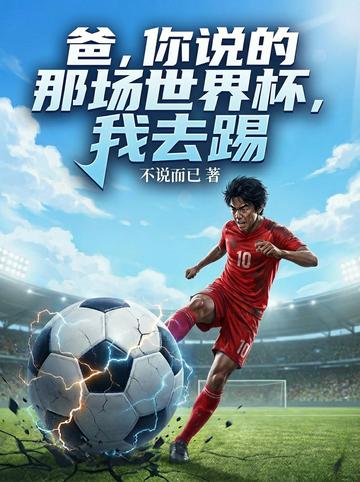
My dad has watched Chinese soccer for thirty years. Every loss, he wrote down in his notebook.
He kept writing from the year we failed to qualify for the World Cup, through the year I was born, all the way until I was seventeen.
He never once said the word “disappointed.” But I knew: every time he closed that notebook, he did it more slowly than when he opened it.
I had no coach, no team, no field. For two years, I kicked a ball against a brick wall all by myself.
Then a notice for the City Cup went up...
I rounded up four guys, borrowed a jersey with holes in it, and got our PE teacher to coach us. That was how we went.
Our opponents were a private school with a full-time coach, corporate sponsors, and jerseys that cost more than our entire annual budget.
But I played soccer differently from everyone else.
I didn’t chase the ball. I chased the place it was going.
We won the City Cup, then the provincial league. Every time we won, my dad opened that notebook in the stands and wrote it down, stroke by stroke.
He’d been keeping those records for thirty years, and no one had ever helped him move that story forward by even a single step.
Now someone had.
But a man had appeared from nowhere and kept following us. Gray jacket, black notebook. He asked my coach one question:
“What does that number ten’s father do?”
And then there was an opponent named Xiao Tianlang, who used exactly the same way of playing against me.
For the first time on the field, I felt as if I were playing against myself in a mirror.
Dad, that World Cup you’ve been waiting for...
I’ll play in it for you.