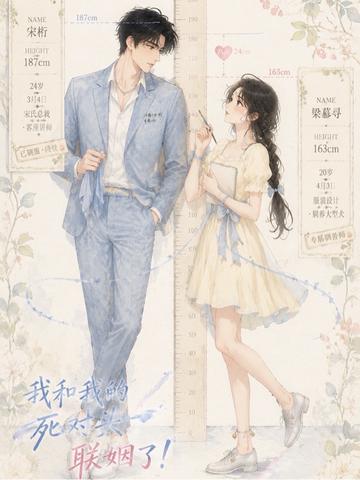
The thing Song Heng regrets most in his life is telling Liang Muxun she had stolen his candy on her sixth birthday. She held a grudge for fourteen years, calling him her “enemy,” glaring whenever they met and snapping at him at every opportunity. But Song Heng remembered those fourteen years too: the soft “Brother Ah Heng” she murmured when she crawled into his bed to hide from a thunderstorm; the way his heart raced when she fell at the sports meet and cried out his name; and the words on the back of a drawing covered in his name: “Heng the puppy, your wife loves you so much.”
When they were twenty-two, their parents suddenly arranged a marriage between them. Liang Muxun slammed the table and objected, while Song Heng said expressionlessly, “I have no objections,” gripping the marriage agreement so tightly beneath the table that it creased. On her twenty-fourth birthday, Liang Muxun spent several sleepless nights sewing him a suit by hand. Song Heng cried when he wore it. At twenty-five, after Song Nian was born, Liang Muxun crouched in the study and cried as she struggled with postpartum depression. Song Heng rushed in barefoot, knelt down, and held her as he said, “You're first. You'll always be first.”
From crawling into each other's beds during thunderstorms at eight to bickering and squabbling as “enemies,” from an awkward engagement to the midnight words “Good night, sweetheart. You're my one and only,” Song Heng waited fourteen years to hear her call him “a good husband.” Liang Muxun was kept in leg chains, draped in scarves, and drawn by him for a lifetime, only to realize later that her “enemy” had done just one thing from beginning to end: used every stubborn excuse to say the most sappy things.
Packed with laughs and overflowing with sweetness, this story stays focused on the couple, with supporting characters appearing only in conversation. It's a story of “You think I'm fighting with my enemy, but I'm actually secretly marrying you.”