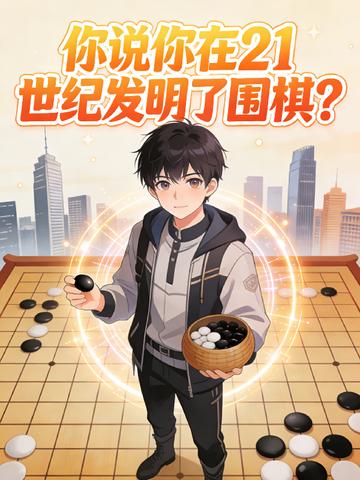
Lin Yan transmigrates to a world with no Go.
No one knows what unfathomable wisdom and strategic depth are hidden in the black-and-white contest across the nineteen lines.
Lin Yan has no intention of stepping into the limelight and becoming a legend. Using only the anonymous ID “Xuan,” he posts the most basic rules on a forum.
At first, the whole internet mocks him: “A territory-grabbing game for little kids playing house, and you call it a board game?”
Later, he posts life-and-death problems, joseki, opening strategies, and midgame tactics in succession. Players everywhere are left reeling: “Does this game have any limit to its depth?”
Later still, professional players bow their heads and ask to become his disciples, the authorities officially endorse the game, and a global Go craze takes off. The title “Master Xuan” becomes a spiritual icon in the hearts of all Go players.
Everyone searches for the founding master of Go, never imagining that the legend is hiding on a university campus.
Then the world’s first Go AI, “Apocalypse,” makes a stunning debut, defeats twelve of the world’s top players in a row, and declares that human Go is no match for it.
With the entire internet in despair, Lin Yan enters the tournament under his real name and takes a seat across from the AI.
Only then does the world learn that the Master Xuan they had admired for years was never some reclusive old man.
And the true heights of Go are only beginning to be measured today.
When I was in elementary school, I chose Go as a course in the school. I studied Go for three or four years, and then I stopped learning it when I entered junior high school. Now it's time for an internship in college. Reading the book really reminded me of the time when I first learned it when I was a child. In fact, this kind of book is not popular. If you don't have some basic knowledge, you won't be able to experience the fun. For someone like me who has only learned the basics and hasn't practiced for a long time, reading this kind of book is very comfortable and gives me a feeling of reminiscing. I won't comment too much on the writing style. I'm purely rating it based on my own feelings, whether it's AI or shi. I have a filter in my eyes so I can't tell. The review I wrote last night was during emo time.
I want to talk about why Go is counterintuitive. The rules of Go are nothing more than five: 1. Take turns. 2. Exhaust your energy. 3. Stay tight. 4. All identical items are prohibited. 5. The ending is empty. Although, there is no consensus on the current Go rules for the above five points. For example, Ying's rules have no forbidden points. For example, Chinese rules and Japanese and Korean rules have different definitions of "empty". For example, the prohibition of all transactions is rarely strictly enforced. But overall it's pretty much the same. However, there is a disconnect between the first four "rules of chess" and the last "rule of victory or defeat". Let's talk about chess. The victory or defeat is determined by capturing a specific chess piece, so there will be descriptions related to capturing pieces in the rules of chess. In flying chess, the victory or defeat is determined by moving to the end point, so there are movement-related descriptions in the rules of chess. However, the victory or defeat in Go is determined by going around and empty, but there is no related description of going around and empty in the rules of chess. Therefore, in a world where Go has not been invented, the primary issue is not the layout theory or the theory of life and death, but how to understand this meta-question and how to understand why the underlying code of Go is so weird. I personally feel that the depth of this issue is enough to write several papers. It's just that in our world, because Go has been invented long ago and habits have become natural, we have not thought deeply about this issue. But if I really want to think about this question, I don't think Ke Jie can answer it.
It's good, but I think it should be more entertaining. Otherwise, it all depends on computing power. After AI came out, there was no way to survive at all. Especially in today's society where AI has been directly developed, it will directly crush everything when it comes out. That is, when playing chess, you should play the kind that has a certain degree of symmetry and is enjoyable to watch. Just like the ancient ones.
I'm curious about what the anchor will write next. It's unlikely that the protagonist's experience will last a lifetime. There must be some kind of real genius.
4 Stars is given because the setting is interesting and very good, but 1 star is deducted because the writing is really not that good. The author obviously feels that his writing skills are insufficient, but there is indeed improvement in the subsequent writing, which is a bit of a pity.
The idea is good, but the writing is not good
Creative, good ideas ai article
It has a strong sense of immersion and is suitable for me who only knows the rules of Go.
I haven't played Go for a long time.
The subject matter has changed in a different direction 😏