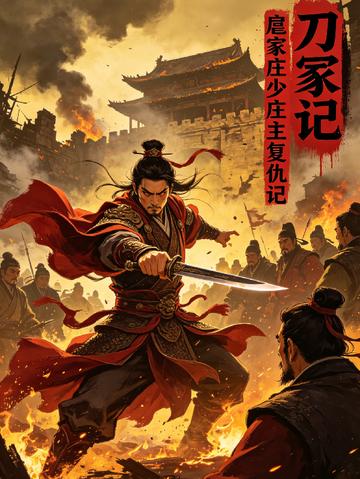
The broad axe in Li Kui's hands did more than smash open the gates of Hu Village. It shattered everything one young man believed about the world: about justice, about power, and about what it meant to be a “hero.” When Hu Cheng escaped Li Kui's axe, he finally understood:
So-called heroes were just a doctrine that glorified violence and bloodshed. So-called “acting in Heaven's name” was just embroidery on a butcher's knife.
That realization turned him from a man into a blade.
A blade has no warmth. A blade needs no justice. It needs only a target, someone to bear the full force of its hatred. Song Jiang, Wu Yong, Li Kui... For five years, those names rolled across Hu Cheng's tongue, wearing it raw, calloused, and into the only reason he had to keep living. He fled to Yanan Prefecture and reforged himself on the training ground of the Zhong family army.
Wang Jin, an instructor in the Zhong family army, taught him swordsmanship, spears, and staff fighting. The army's officers taught him patience. He learned well. So well that he forgot he had once been human. So well that his father's smiling face no longer appeared in his dreams, replaced by a blood-red lake.
Some call this growth. I call it a sacrifice.
Hu Cheng sacrificed himself to hatred, just as his kinsmen had been sacrificed to Liangshan's “great cause.”
Clarity is painful. But pain can make a person sharp.
In the spring of the first year of Xuanhe, the blade finally left its sheath.
Five hundred cavalrymen, a full battalion, set out from the northwest and headed straight for Liangshan Marsh. Hu Cheng rode on horseback, one hand on his sword hilt, gazing at the waters that had once swallowed everything he had. His face was expressionless, his heart still.
He could no longer remember exactly what his father looked like, or the last time his little sister called him “big brother”

Not bad, very beautiful