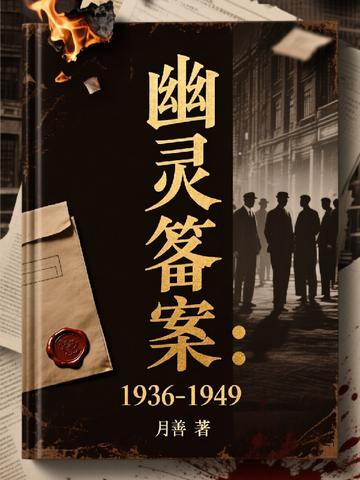
Lin Mo opened his eyes and found himself in 1936 Nanjing, as Lin Yan, a junior clerk in the Fuxing Society.
As someone who had transmigrated, he had two secrets:
First, he could see the labels above everyone's heads: their names, identities, loyalty, and recent keywords.
Second, he knew every major historical turning point of the next thirteen years.
From Nanjing to Shanghai, from the isolated city to its fall, he wore five masks as he walked the edge of the abyss:
The Fuxing Society's “secret weapon,” the Japanese Special Service's “carrier pigeon,” Wang's puppet regime's No. 76's “supervisor,” our Party's top-secret “deep throat,” and the American OSS's “lens.”
Dai Li called him the sharpest blade. Yamamoto Ichiro regarded him as a confidant. Matsushima Yoshiko wanted him under her command. In a top-secret file, Zhou Gong left an eight-character note: “Fit for great responsibility, await the right moment.”
He could not change the bloodshed in Shanghai, the agony of Nanjing, or the storms of the Pacific.
But beneath history's grinding gears, he could lay down a soft cloth:
Let those who ought to die meet with “accidental” deaths, give those who ought to live one more chance, and quietly keep the flame of civilization alive amid the ruins.
1936–1949: one man's war.
He was a watchmaker of history, quietly calibrating the age's hands.