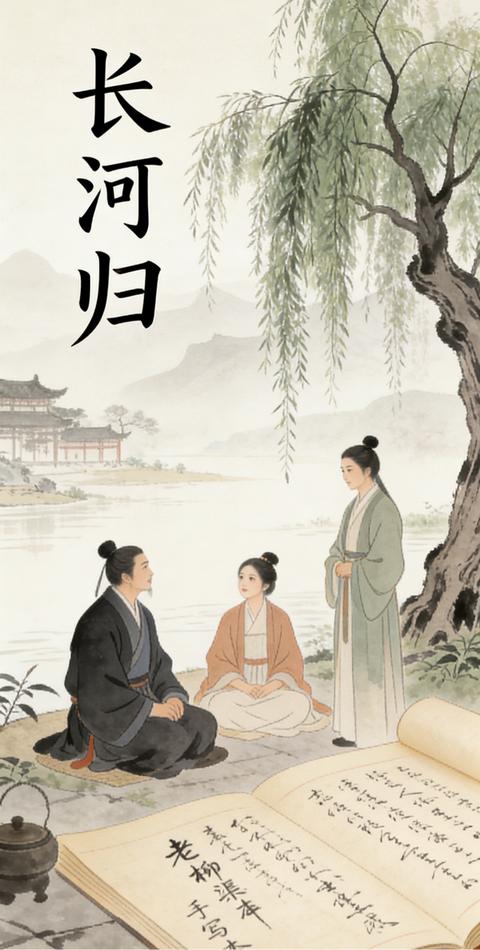
In the winter of the fifth year of the Shaoxi era under the Song, boatman Geng Weili and his son, Geng Bogu, encounter a frail, ill old man beside the Tongji Canal. The old man, surnamed Shen, says he is heading south to search for relatives. The Gengs take him aboard and travel south with him, beginning a decades-long search that spans three generations.
Shen Zhi, whose ancestral home is in Dongjing, was separated from his younger sister, Shen Xing, during the Jingkang upheaval. For forty-three years, he has traveled back and forth between north and south, never giving up his search. Geng Bogu accompanies him south, passing through Chenliu, Dongjing, Fuli, Xuyi, Yangzhou, Pingjiang, and Lin’an, until at last they find Shen Xing in Yuezhou. Forty-three years have passed since the siblings were separated.
Shen Zhi settles in Yuezhou and passes on to Bogu the handwritten book he has carried with him. The thin volume records the places he has visited, the people he has asked, and the news he has heard over half a lifetime. From then on, Bogu takes up this “family letter” and continues writing down what he sees and hears.
After Shen Zhi dies, Bogu fulfills his final wish and returns north along the old route to visit the ancient willow planted in the Sui dynasty. Many years later, Bogu returns to the willow with his son Wangbei. When Wangbei grows up, he visits the tree for a third time with his son, Geng Chuan. The same tree, the same exchange, three generations, and eighty years.
The willow says nothing, yet it has witnessed it all.


 Mr. Lu's Priceless Little Bride
 After the Divorce, My Ex-Husband Chased Me Around the World
 Reborn in the 1990s: My First Fortune from the Junkyard