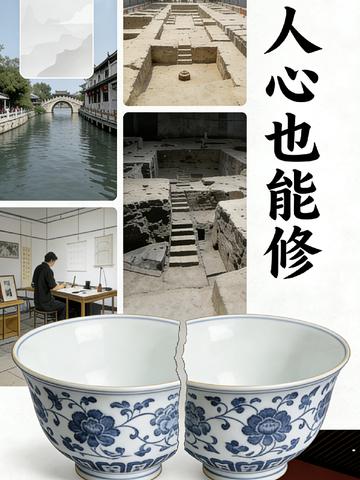
I’m a porcelain restorer. I run the studio my master left me, by the canal in Nancheng. Every day, I mend bowls, cups, and anything else that’s broken. The one thing I don’t believe can be mended is the human heart. When my ex-husband told me, “Fix me,” I said, “People aren’t porcelain. Once they’re broken, they’re broken.”
Until a man came from Xuzhou.
His name was Zhou Yanshu. He knocked on my door carrying half of a blue-and-white porcelain bowl. The name of my master, Yanzhi, was carved into the bottom. I had the other half hidden away, with the words “and his wife” carved underneath.
The moment the two halves came together, a secret buried for forty years began to surface. I followed him to Xuzhou, where he held my wrist in the darkness of a Han dynasty tomb, and to Jingdezhen, where we dug up a letter my master had left for me beneath a pagoda tree.
The letter said, “I chose that boy, Yanshu. He can be there for you.”
The restoration of the wood-fired kiln failed three times. When he went to Anhui to find paper, he got trapped in the mountains and lost contact. I stayed alone by the kiln, facing the direction of the search teams, and said, “If anything happens to you, I’ll never forgive you.”
He came back. The kiln was restored.
Later, at the Palace Museum’s Intangible Cultural Heritage exhibition, the two bowls shimmered with golden cracks under the lights. Someone asked me, “What matters most in kintsugi?”
I said, “Admitting the damage. Only when you acknowledge that something is broken can you begin to mend it. The human heart is the same.”
That evening, beneath the old pagoda tree, he gave me a porcelain ring he had fired himself.
I waited thirty-four years, and at last I found someone who made me believe that the human heart can be mended, too. And once it is, it can never be parted again.