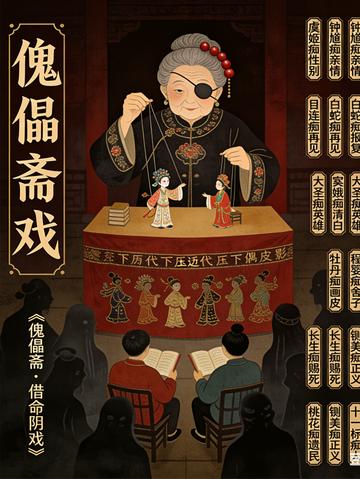
In the late Qing and early Republican era, the wandering opera troupe Puppet House specialized in ghost operas. The troupe leader, Granny Huai, had one eye and prayer beads made of sandalwood. With silken threads, she drew the living into puppets and borrowed their lives to put on a show. Every performance needed one “puppet”: once onstage, the person's consciousness entered the puppet. When the show ended, they would get what they wished for, but would gradually turn into a puppet: their skin hardened, their joints rusted, and their five senses faded. Those who became full puppets remained props forever. The only way out was to find someone else willing to take their place.
Yu Ji was obsessed with love between men and women, Zhong Kui with family bonds, Mulian with seeing someone again, the White Snake with revenge, the Great Sage with being a hero, Dou E with clearing her name, the Peony with painted beauty, Cheng Ying with sacrificing a child, Changsheng with being granted death, the Chopping-Platform Case with justice, and Peach Blossom with loyalist remembrance. Twelve obsessed souls, twelve borrowed lives, twelve plays within plays.
Granny Huai was once the first puppet, a famous performer during the Daoguang era. She entered the play to save the troupe and has spent two hundred years searching for someone to die in her place. The troupe never performs three days in a row and never returns to an old venue, because beneath the stage carpet lie the shadow puppets of every puppet from past generations. Perform too long, and the boundary between yin and yang will solidify, trapping the puppets inside.
Now a folklore student has tracked them down. The moment they turn a page, they take a seat; the moment they watch the play, they enter it. The page number is their seat number, and every reader is an invisible ghost. The obsessed souls are paired up, spectators become performers. Who is the puppet, who is Granny Huai, and who is the play?
The play is not over. The gong sounds again.
Really good