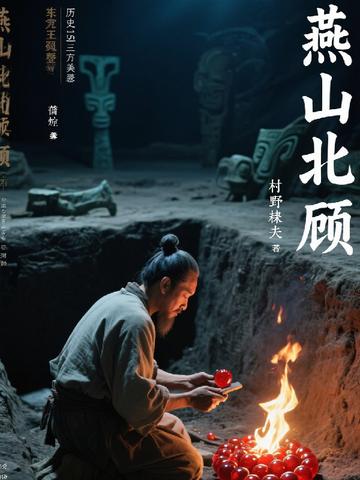
1150 BCE, the night before the sacrificial pits at Sanxingdui are to be buried. A jade craftsman named Pugen kneels beside the pit, watching the carnelian beads he polished being cast into the fire.
Three years earlier, he had licked a red stone, and the tip of his tongue had tasted the bitterness of the northern mountains. The King of Shu had told him to find where the stone came from. He set out north with twenty men, crossing the miasma of the Qinling Mountains, the silence beneath the cliffside coffins, and the territory of black bears. Along the way, some leapt from cliffs, some were carried off by wolves, and some died in icy rivers.
Beyond the Yin Mountains, a banished boy from the grasslands named Geng said, “Take me with you.” The Han Zhong priestess Sijiang insisted on joining them, saying she had dreamed of a visitor from the south bearing a red glow. The blind Gusou drew maps with his ears and told them the road was not beneath their feet, but in the mouths of the people along the way.
Three years later, seven of them returned. Sijiang stayed on the grasslands to teach people how to farm. Geng became a tribal chief. Jiong knelt amid the ruins, rebuilding his Qiang tribe. The ore Pugen brought back was ground into three hundred and sixty beads. Three hundred and fifty-nine were buried in the sacrificial pit. He clutched the last one, no bigger than a soybean, as he died.
Three thousand years later, a scientist peers through a microscope: the bead came from the Yan Mountains. Outside the window, a boy gazes at it through the glass. He does not know the craftsman was named Pugen, or how to travel three thousand li. But the bead is red as blood, red as the sun, red as a place far, far away.






The craftsman who licked the stone went all the way to Yanshan and died. Pu Gen has always believed in a dead truth: wherever the stone comes from, he must go there. Twenty people followed him, and as they walked, seven remained. He picked up the bones of those who died in the miasma, those who died under bear paws, and those who died in the glacier, wrapped them in cloth, and carried them back on his back. This is not a story about princes and generals, but a bunch of little people who risked their lives on a three-thousand-mile journey for a red stone. Gen said, "Take me away," and Si Jiang said, "I want to see if it's true." Hu didn't complain from the beginning to the end. They don't understand the righteousness of the family and the country, but they know that what they promised must be done. He was reluctant to bury the last bead and held on to it until death. Three thousand years later, it was dug out of the soil, and it was still red. I wasn't tired from reading this book, but I was bored. When those people walk on the road, they say and do things as if they are really in front of you. They also miss home, their wives and children, but they still have to move forward. Mao asked his master: "Why do you have to walk so far?" Pu Gen didn't answer. In fact, he answered - he held on to that bead all his life. Three thousand miles of mountains and rivers, one red stone, and a group of people. Three thousand years of dust has covered it, and there are still things that make people feel distressed.