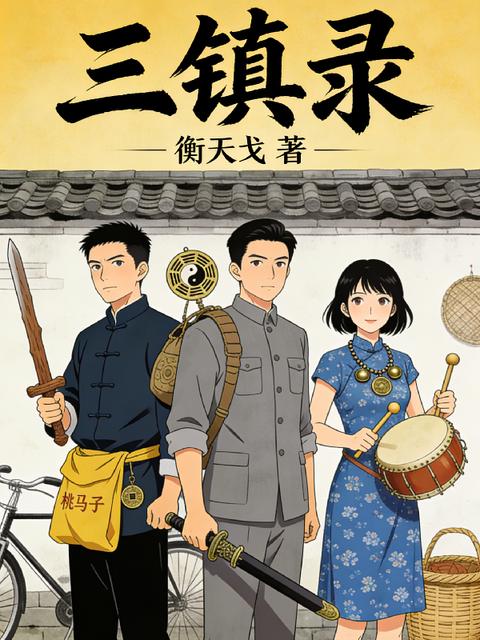
In 1972, three red lines held back the legacies of three different traditions.
Hu Yishan, a disciple of the horse-riding spirit medium tradition, was buying furs in Changbai Mountain. He carried a book called Illustrated Guide to Medicinal Herbs, with an unsigned spirit altar register tucked inside. He only wanted to get through the next few years in peace and return to his hometown in Shandong once the pressure eased. Then, deep in the storeroom of a purchasing station, he saw the “Mirror of Retribution” that had been sealed away for twenty-three years. What it reflected was not his face.
Chen Qingyuan, a Maoshan disciple, worked in the Chinese medicine dispensary at the county hospital. Locked in the bottom drawer of the medicine cabinet was a sandalwood case containing not ginseng or deer antler, but half of the Secret Manual for Subduing Evil. Before his master died, he said, “Our lineage’s debts must be repaid in the Northeast.” Chen never imagined his first lesson in repayment would be saving a commune secretary afflicted by a “nightmare seal.”
Jin Ying, a shaman’s disciple, worked as a barefoot doctor at a forestry farm clinic in the Greater Khingan Mountains. Beneath the bottom of her medicine chest lay a single-sided hide drum. Her grandmother had been the last shaman of the Oroqen people. As she was dying, she gripped Jin Ying’s hand and said, “The mountain god is old. He can no longer guard all those things.” The first person to seek Jin Ying’s help was a lumberjack plagued by a “tree curse.”
The three seemed to have nothing to do with one another, until an old case involving a missing seal object slowly drew them together. From forestry farms to coal mines, from old towns to the border, the objects that had “disappeared” during the campaign to destroy the Four Olds, the coin sword, the mountain god statue, the feng shui stele, were beginning to awaken one by one. And those who had buried them with their own hands years ago now had to find them all again, because a new wave of evil was stirring.