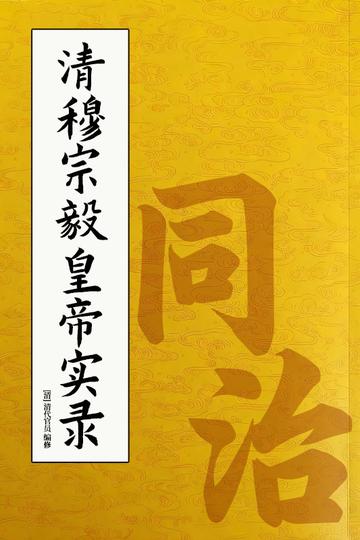
"Records of Emperor Mu Zongyi of the Qing Dynasty" has a total of 374 volumes. It records the end of July in the eleventh year of Xianfeng and December of the thirteenth year of Tongzhi.
Zai Chun, Muzong of the Qing Dynasty, Aixinjueluo Zai Chun (1856-1875) was the eighth emperor of the Qing Dynasty. Reigned from 1861 to 1875, with the reign title Tongzhi. In July of the 11th year of Xianfeng's reign, Emperor Xianfeng passed away. The ministers were busy managing the funeral and at the same time handling government affairs for the newly ascended six-year-old emperor. The reign name of the Yuan Dynasty was changed to "Qixiang". In accordance with Wenzong's order, eight ministers assisted the government, and the two queen mothers did not interfere in the government's affairs. The power-hungry Cixi launched a power struggle within the palace. In September of the 11th year of Xianfeng's reign, Sushun and others helped Wenzong Zi Palace return to Beijing. The two empress dowagers took the young emperor and returned to Beijing on another journey. Cixi and his entourage arrived first and led the troops with lightning speed, and captured the eight ministers. They were charged with "conspiracy to do evil". They were beheaded, sentenced to death, and dismissed from their posts. They abolished the "Qixiang" reign title. On October 9th, Chun ascended the throne and was changed to "Tongzhi" to express the intention of the two empresses to govern the world at the same time. The two empresses broke the ancestral system and implemented the practice of listening to politics behind the curtain. It was Cixi who was really in charge of state affairs. Emperor Tongzhi died in December of the 13th year of Tongzhi. He took charge of the throne for two years and was 19 years old. He was the shortest-lived emperor in the Qing Dynasty. Buried in Huiling, Eastern Tomb of the Qing Dynasty.
Emperor Tongzhi had no children, and then Emperors Guangxu and Xuantong had no descendants. For decades, no children were heard crying in the palace, which is known as "the palace is deserted" and "the three wonders of national unity". The superstitious old and young all lamented that the fate of the Qing Dynasty was about to run out, and the fortunes of the Qing Dynasty were determined.