


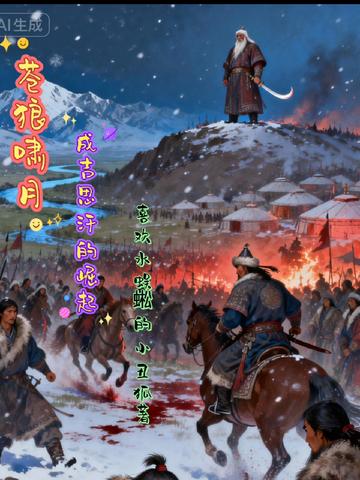
The Wolf Howls at the Moon: the Rise of Genghis Khan
苍狼啸月:成吉思汗的崛起
- Status
- Completed
- Length
- 738k Words
- Genre
- Historical
- Subgenre
- Historical & Ancient
- Updated
- 5mo ago
- Source
- Fanqie
Stats
150Chapters
5.8Score
24Reads · all time
Tags
Synopsis
More by this author
 Thriller Game: Moans in the Funeral Home
 Fantasy Novel Earthlings from Extraterrestrials
 Seventy Years of Changes in Market Regulation
 The Secret of Blue Cloth Umbrella
 Wu Zetian Is Reborn in a New Generation
 Don't Go Through the Difficult Road.
 Great Sage, I Have Come to Make Trouble with You in Heaven
 Real Estate Tycoon's Mirage
 Heavenly Retreating Star: Winged Tiger——lei Heng, the Leader of the Marching Army
 Qin Shihuang's Cabinet of Thirteen Prime Ministers
 Sails in the Dragon Palace: Jiang Ziya's Rebirth
 Black Gold Puzzle
In booklists 1




Reader comments 1
Google Translate
Jamuka's words before his death, "If there is an afterlife, let me win once" condensed a lifetime of pride and unwillingness into a bitter smile, while Temujin's promise of "I promise you" completed the final reconciliation between the pair. The author concludes the chapter with a broad perspective, making the kowtows of the old ministers become witnesses of the transition between the old and the new era - when personal grievances are sublimated into the imperial order, the grassland truly enters a new chapter in the history of "Great Mongolia". This narrative wisdom that transforms tragedy into constructive force is the most moving part of this chapter. "The Wolf Roars at the Moon: The Rise of Genghis Khan" completes a panoramic narrative about the world conqueror with a grand scale of one hundred and fifty chapters in six volumes. The author breaks through the linear structure of traditional biography and weaves military conquest, political system, cultural integration and ecological changes into a multi-dimensional historical picture. It not only presents Genghis Khan's personal legend from an exiled orphan to the founder of the empire, but also reveals the deep significance of the Mongol Empire as a "turning point in world history". The outstanding value of this book lies in its methodological innovation. The author skillfully uses the perspective of global history to place the grassland at the center rather than the edge of the interaction between the Eurasian continent, and examines how technological diffusion, religious tolerance, and commercial networks restructured the map of civilization along with the iron cavalry. At the same time, he introduces cutting-edge perspectives such as gender history, environmental history, and digital humanities, giving Hoelun's political wisdom, the carrying limits of grassland ecology, and the contemporary reconstruction of historical memory an equally important narrative position. This interdisciplinary synthesis avoids the romanticization of the heroic view of history and the curiosity of Orientalism, and achieves a rare balance between academic rigor and readability. As a historical writing for contemporary readers, this book is more realistic. From the global circulation of the "Genghis Khan brand" to the evolution of the image in video games, from the connection between climate change and the rise and fall of empires to the ecological enlightenment of nomadic wisdom, the author constantly establishes a dialogue between history and the present, making the conquerors eight hundred years ago a mirror for reflection on globalization, technological ethics and cultural identity. The final chapter, "The Wolf Roars at the Moon," ends the whole story with a poetic touch. It is not only a farewell to the legend, but also a confirmation of the eternity of historical memory - the legend ends, but the questioning never ends. This is a work with both epic spirit and ideological depth, setting a new benchmark for the study of the Mongol Empire in the Chinese-speaking world.