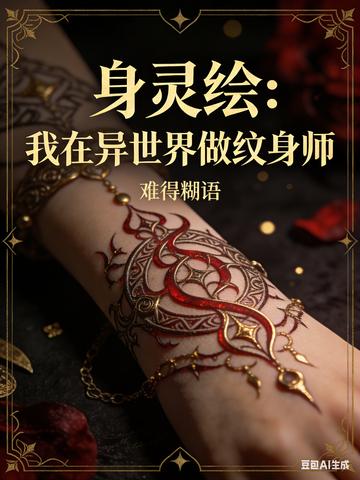
In the world of painted spirits, there is an ironclad rule: anything can be painted, but never on human skin.
Because paintings devour people. On paper, a painting is a technique. On skin, it's a curse.
Before he transmigrated, Lin Quan's last painting was a crow without eyes. Afterward, his first was a quicksand pit that swallowed people. He traded tattoos for steamed buns on the black market, fooled ancient formations with perspective, and used the question “Where would you dare get a tattoo?” to gain entry to the seven great schools.
Yan Zhenqing measured his bones with an iron ruler and said his paintings had no bone structure, that they were a disgrace. Bai Wuxia scrubbed his skin with a cleansing brush and said his paintings were too crowded, a contamination.
Lin Quan said, “People make the frames. I choose to paint beyond them: on bones, in souls, beneath the world's skin.”
As his tattoos multiplied, Lin Quan realized he was becoming “thin.” Not thinner, but two-dimensional. His skin took on the texture of rice paper, his blood grew as thick and bitter as pine-soot ink, and whenever his heart beat, he heard the scratch of a brush between his ribs.
And the poems tattooed on his body, “Bring in the Wine” and “Snow on the Cold River,” along with the winter crow whose eyes would never be finished, were slowly taking over his body heat.
When the Erasers prepared to unleash the Great Blank, washing all living beings into empty scrolls, Lin Quan took off his shirt at the Flying White Ceremony.
There was no blank space on his body.
Only a painting of the human world, growing flesh and blood.