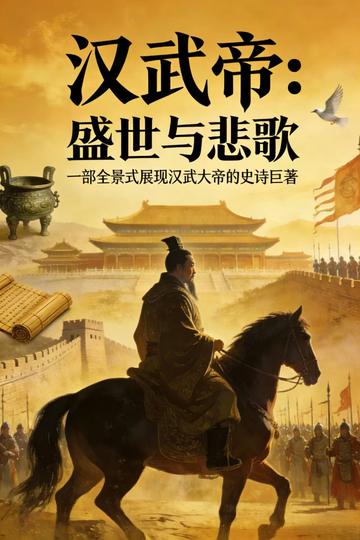
Emperor Wu of Han: Glory and Lament is a historical novel in four volumes, centered on the fifty-four-year reign of Emperor Wu, Liu Che. Going beyond one-sided praise of a great ruler’s accomplishments, the novel takes as its theme “The mighty Han beneath the boundless sky, the towering Weiyang Palace,” and delves into the complexities at the heart of the empire’s golden age. It captures both the daring ambition behind opening the Western Regions and the resolve to punish enemies no matter how far away, and the hardships endured by the people beneath the marching armies, the ideological consolidation behind Confucianism’s dominance, and the shared fate of emperors, ministers, and commoners amid the splendor of a golden age.
Taking in a panoramic view that spans the imperial court and the distant reaches of the realm, the novel weaves together the fates of historical figures such as Emperor Wu, Wei Qing, Huo Qubing, Sima Qian, and Sang Hongyang, and fictional characters such as Lu Jing, a scholar from a humble family, and Seleucus, a merchant from the Western Regions. Together, their stories form a profound portrait of power, ideals, sacrifice, and reflection. From a young emperor’s first tests of power, through the empire’s trials of strength and its flourishing prosperity, the story ultimately reaches the ruler’s twilight years and reflections on the decline that follows an age of greatness. It asks whether the name “Weiyang,” meaning “never-ending,” is a wish for splendor to endure forever or an omen that prosperity must give way to decline. This is an epic rich in historical depth, literary warmth, and human feeling. It explores how a nation can balance ambition with good governance on its path to greatness, and how individuals may shine or be lost amid the tides of history.