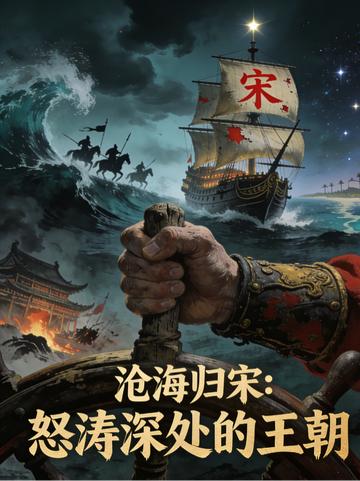
Return to Song Across the Vast Seas
In the winter of the ninth year of Xianchun, every beacon fire along the Yangtze went dark.
Fifteen-year-old Zhao Xing, Prince of Jinghai, opened The Tribute of Yu and held his finger above the blank space beyond the shores. “Your Majesty, the nine provinces on land have fallen. We must establish the nine provinces at sea.”
This was no flight. It was a game of strategy with civilization at stake: the white pieces were Mongol cavalry, while the black pieces were Song ships carrying the master copy of the Yongle Encyclopedia, an armillary sphere, a water clock, and seventy thousand souls. When twelve hundred ships cut through the morning mist of the South China Sea, the first move they made was called “No Return.”
On the three hundredth day, a red continent emerged from the dawn mist. The people with jade-green eyes gazed up at stone walls, while wolf banners from the north had already closed their jaws around the way home. Here:
• The Southern Cross refused annotations from the Purple Star Astrology.
• Where kangaroos ran, the Rites of Zhou had to be rewritten with fresh ink.
• When the first cast-iron flames burned beneath the southern stars, an old craftsman’s tears scorched through the Artificer’s Record.
Zhao Xing raised a new flag atop the mast, inscribed with eight characters from the Book of Documents: “Heaven’s mandate is not constant; those who do good will receive it.”
Three hundred years later, when ironclad ships cleaved through the morning mist over the Pearl River, their songs had mingled with the voices of the natives. The defenders of the old homeland trembled as they saw clearly: beneath a banner bearing stars and waves stood strangers, and also the ancestors they knew best.
This game lasted three hundred years.
The black pieces did not capture the white.
But at the far end of the ocean,
they created a new board.
Fragments of a sea crossing, new laws beneath the stars.
New book seeking attention