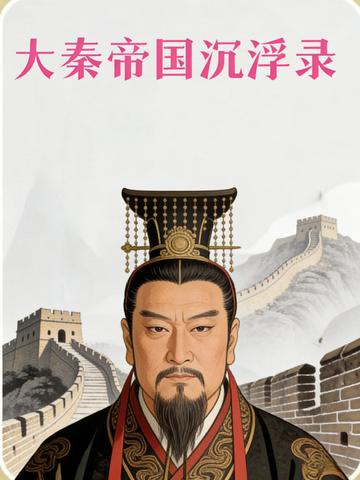
"The Ups and Downs of the Great Qin Empire" takes the warring states as its backdrop and tells the story of the blood and tears and humiliation of the weak Qin under the iron heel of the Six Kingdoms. Land in Hexi was lost, the ancestral temples were covered in dust, and the hungry people exchanged their children for food. The young Qin Xiaogong endured the humiliation and promulgated the "Order for Seeking Talents", and Shang Yang used an iron-fisted approach to reform, move the wood to establish trust, and punish the officials. The old tribes counterattacked, various countries encircled and suppressed them, and the road to reform was paved with corpses. After passing through Huiwen Lianheng and Zhaoxiang eastward, to Yingzheng sweeping Liuhe, the cavalry trampled the mountains and rivers, and Han, Zhao, Wei, Chu and Yanqi were overthrown one by one in ten years. However, the empire suddenly rose and fell violently, books were burned and Confucian scholars were burned, and Afang, the Great Wall, exhausted the people's strength, and finally collapsed in the Daze beacon fire. This is an epic of a weak country's counterattack, and it is also a tragic song that lays the foundation for civilization. Although the Qin Dynasty died, it left China with the gene of unification for thousands of years. Over the years, Chinese children have fought for the reunification of the motherland. The belief that the motherland must be reunified and that the motherland must be reunified is engraved in the bones of the Chinese people.