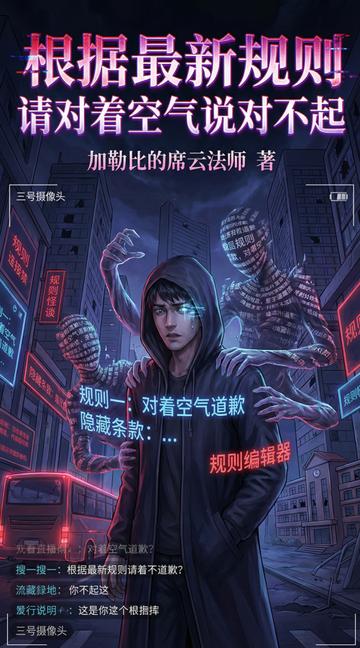
This is an era in which “national destiny competitions” are tied to “rule-based horror.” The entire world has been drawn into a “Rule Season” overseen by a higher-level rule system. Every classroom, instance, and urban experiment directly affects each country’s points and its allocation of real-world resources.
Su Jin, an ordinary office worker, awakens to a special ability in a midnight classroom instance: he can “read and edit rules to a limited extent.” From a student forced to fight for survival, he gradually gets recruited into the Huahai Rules Team and drawn into the heart of the national destiny Rule Season. In classrooms, trains, corridors, night markets, high-frequency minute-rule scenarios, and other settings, he uses a rule editor to save people and earn favorable ratings, while the System reports him as an “abnormal sample” and a “cooperation candidate.”
On one hand, the story follows how he solves problems in the gaps between rules: changing a line of red text, warning someone “Don’t look over there” three seconds before it’s too late, and making choices in national destiny preference tests on behalf of his city and country, even when those choices don’t look good. On the other, it shows how countries and cities use a “Humanity-Side White Paper” and cooperation clauses to negotiate with the rules themselves, gradually moving basic principles like “Don’t apologize to empty air” off the instance blackboards and back into real-world public notices.
The story moves fast, with dense rules and real death and punishment. It offers no feel-good platitudes or talk of fate, only a tale of how, in an era when institutions and higher-level rules keep you under surveillance, one man who knows how to read the fine print can fight for a few more seconds of survival for himself and his entire city, even as he is treated like a test subject.