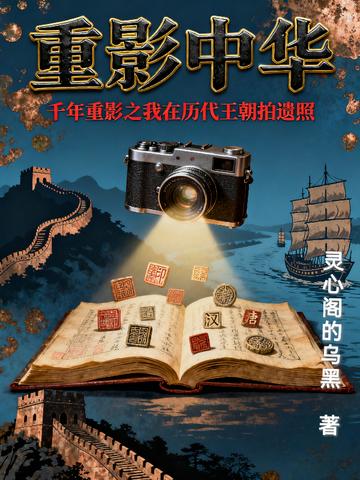
At Pit One of the Terracotta Army, a pattern resembling the walls of Rome suddenly appeared on the floor of a bronze chariot. The moment archaeologist Lin Mo touched it, he was drawn into a "superimposed state of time-film": the main world was the "developed layer," while parallel worlds were the "latent-image layer." Every time he anchored himself across time, he had to carve a hidden historical map into a cultural relic within 72 hours. Otherwise, all related memories in the main world would collapse completely, and his consciousness would be trapped forever in the "cracks of the latent image."
From Xianyang Palace to Weiyang Palace, from Red Cliff to the Shu Road, from Bianliang to Nanjing Harbor, Lin Mo took on the role of strategist in different dynasties. Driven by his fixation on a ring he had never managed to give, he carved the Great Qin Map of the World, Silk Road coin molds, the Red Cliff ship's rudder, a railway map of Yanyun, and Zheng He's nautical charts into cultural relic anchors. He fought the Shadow Cult, which colluded with the Xiongnu and Japanese pirates, and defended the dream of Great Qin unifying the world.
In a modern laboratory, his junior fellow student Chen Xiaoyu clutched a record book, using her brain waves to resonate with the magnetic fields of cultural relics. She evaded the Shadow Cult's assassins and stopped bomb attacks, answering Lin Mo's obsession with her own devotion across time.
When all the anchors finally converged at Xianyang Palace, the ultimate choice lay before them: destroy the anchor chain and they could stay together, or preserve it and be separated by time forever.
This is a battle to anchor time spanning the Qin, Han, Ming, and Qing dynasties; a promise across lifetimes forged by obsession and devotion; and a civilizational awakening in which humanity embraces the coexistence of multiple histories. Every mark carved into a cultural relic conceals the code for "the world moving on one track, civilizations flourishing together."