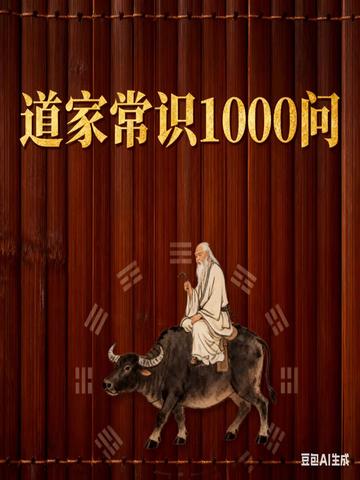
Taoism is an important school of traditional Chinese culture. It takes "Tao" as its core philosophical concept and advocates conformity to nature, tranquility and inaction, and the unity of nature and man. The source of his thoughts can be traced back to Laozi in the Spring and Autumn Period. He proposed in the Tao Te Ching that "Tao gives birth to one, one gives birth to two, two gives rise to three, and three gives rise to all things." He emphasized that all things originate from the evolution of "Tao" and advocated the wisdom of governing by inaction, and that the weak prevails over the strong. Zhuangzi further developed Taoist thought. Through chapters such as "Xiaoyaoyou" and "Equality of Things", he used fables and philosophy to explore the freedom and relativity of life, advocating transcending worldly constraints and pursuing spiritual freedom.
Taoist thought has profoundly influenced Chinese politics, philosophy, art and health care fields, such as the governance practice of "Huang Lao's Art" in the early Han Dynasty, the rise of metaphysics in the Wei and Jin Dynasties, and the formation of health care cultures such as Tai Chi and Qigong in later generations. Its core concepts, such as "the best good is like water" and "misfortune lies on the basis of blessings", have become important spiritual symbols of Chinese culture. Taoism is not only a philosophical system, but also an attitude towards life. It emphasizes maintaining inner peace and transparency in a complicated world, which has important implications for modern people's pursuit of physical and mental harmony.