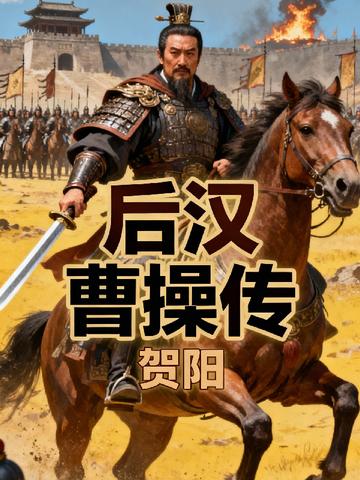
In the final years of the Eastern Han Dynasty, blood stained the palace walls and refugees filled the roads. While the powerful struggled to preserve their own safety, Cao Cao set out from Qiao County. Born into controversy as a descendant of eunuchs, he threw the board of a chaotic age into disarray.
His wild streak showed from an early age. At five, he stood his ground when he encountered a water snake, driving it away with a blade of grass. At thirteen, after his uncle caught him hunting, Cao Cao pretended to suffer a stroke and fooled him. His youthful cunning tore through the hypocrisy of the adult world. This ruthless refusal to follow convention would later become his sharpest weapon for breaking deadlocks.
At twenty, he became the Northern Commandant of Luoyang. Seeing that the capital's laws were no more than paper, he hung five-colored staffs at the four gates and declared, “Anyone who breaks the law will die, noble or commoner.” When the uncle of the powerful eunuch Jian Shuo slipped out through the city gate, everyone else feared his influence. Cao Cao had him beaten to death in public and left his body exposed for three days. He made his authority known in blood, and no powerful figure in northern Luoyang dared cross the line again.
The chaos brought out the full measure of his ambition. When the warlords rose against Dong Zhuo and the others hesitated, he led a few thousand men straight into Hulao Pass. Even defeat at the Bianshui River failed to break his spirit. After escorting Emperor Xian to Xuchang, he did not chase the empty reputation of “holding the emperor hostage.” Instead, he established agricultural colonies, bringing refugees back to the fields and making barren land yield grain. At the Battle of Guandu, he defeated Yuan Shao's army of a hundred thousand with a smaller force. He appointed people solely for their abilities, and was willing to give even men accused of adultery and bribery positions if they were capable, opening a path to advancement for those born outside the great clans.
Some called him a “villainous hero,” forgetting that in a chaotic age there are no perfectly virtuous heroes. He did not pretend to be a gentleman seeking fame. He used an iron hand to reunite the north, while the poetic spirit behind “An old steed in the stable still longs to gallop a thousand li” concealed the tenderness within the ambitious warlord.
Centuries later, the debate continues, but no one can deny this: he was the boldest player in the late Han Dynasty, and a figure in history so vivid that no one can ignore him: a true hero.