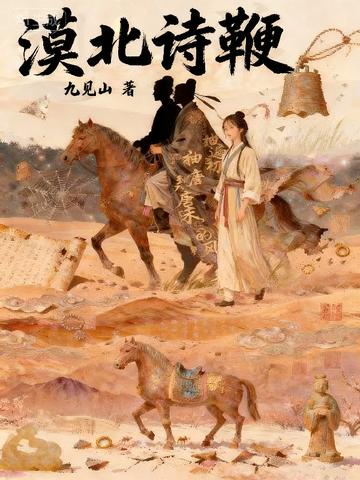
I transmigrated into a shepherd boy on the grasslands north of the desert. With a whip in my left hand to drive the sheep and a brush in my right to write poetry, I ask you: who says nomads can only bend their bows? Why shouldn’t my verses be able to turn the winds of the Tang dynasty?
In the Zhenguan era, I wrote “The wind parts the grass to reveal the banners” by the Wei River, and Li Jing clapped me on the shoulder and said, “This kid knows more about war than Hou Junji.”
During the Kaiyuan era, I drunkenly wrote “A full moon hangs over Chang’an, sending ten thousand poems tumbling down” in a Chang’an winehouse, and Li Bai snatched my brush, shouting, “Bring us another three jin of wine!”
By the Tianyou era, I had inscribed “The setting sun melts like gold as I weep for the prosperous Tang” on the ruins of Luoyang. Behind me was the smoke of Huang Chao’s rebellion; before me lay the Tang dynasty’s final sigh.
Across three hundred years of Tang history, I rode from the northern grasslands to the south, writing poems about the blood at Xuanwu Gate, the smile of Yang Guifei, and the tears of the An Lushan Rebellion. I also used my whip on officials who bullied herders, barbarians who invaded the frontier, and traitors who betrayed their country.
Some call me the “Poet Immortal of the Grasslands,” while others curse me as a “madman of chaotic times.” But all I want is to capture the winds from the early Tang to its final days in my poems. After all, over the Tang dynasty’s three hundred years, I’m the only witness who lived it from beginning to end!
At first, he is happy, excited, and wild... until Wan’er dies, and he slowly comes to his senses. In the early part of the story, his life is full of ups and downs as he gradually grows.
In the middle, he remains in a constant state of exhilaration. He makes friends through poetry and goes undefeated across the land!
By the end, he has gone completely mad. The era he lives in turns out to be so tragic!
At last, he wakes up. Not from a dream, but to wakefulness itself!