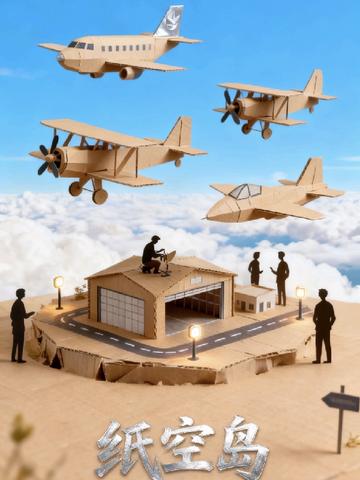
As the gale sends scraps of cardboard skittering past the cliff, Lin Ye and six strangers huddle inside a wobbling prototype aircraft. For the first time, they understand the weight of “flight.” The fuselage is made of damp cardboard, propulsion comes from a hand-cranked paper fan, and beneath them lie an unfathomably deep sea of clouds and the water below.
This is Cardboard Sky Island, an aerial arena built from craft knives and tape. Every team is made up of newcomers, each with only a “junk prototype” supplied by the organizers. There are no instructions and no way back. Over the 120-day season, they must patch their wings in torrential rain, adjust their tail fins in turbulent air, and fight for survival resources amid narrow cardboard buildings.
Lin Ye's team keeps saying, “If only it were a little wider.” They want to build a plane everyone can stand steadily in, a sturdy “big bird” capable of carrying cardboard and trust through the skies. Other teams are obsessed with shortening their fuselages so they can dart about like hummingbirds. Some are determined to make cardboard rotors spin, hoping to escape their gliding fate. Others want only to follow the wind, letting their tail fins point the way like weather vanes.
No one knows why the sky island exists, or what the next mission will bring. But as tape binds a broken wing, as a paper fan spins up thrust to fight the gale, and as six pairs of hands grab the same cardboard control stick amid the turbulence, they gradually realize that what carries cardboard far into the distance has never been technology. It's the understanding and courage that take root in the cracks.
This is the story of a group of people folding the most makeshift materials into flight paths of their own.