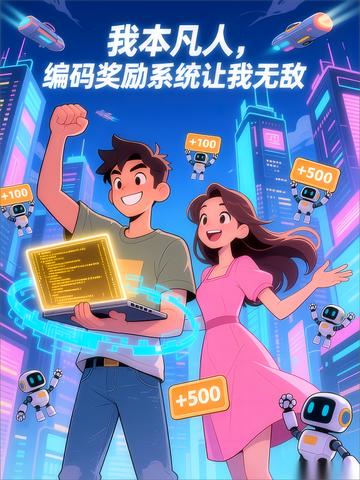
I'm Just an Ordinary Man, but the Coding Reward System Makes Me Invincible
我本凡人,编码奖励系统让我无敌
- Status
- Ongoing
- Length
- 333k Words
- Genre
- Urban
- Subgenre
- Urban Everyday
- Updated
- 10h ago
- Source
- Fanqie
Stats
138Chapters
33Reads
8.6Score
5Listens
1.8kReads · all time
Tags
Synopsis
More by this author
In booklists 7
I'm Going Through a Reading Slump. Are There Any System Novels That Can Help Me Get Through It?
956Books7.6MViews1dUpdated

New Book Swap and Reviews
Looking for books similar to *Phantom Eighteen Needles of Medicine King Valley*. New-book review swap: reply if you’re interested. Listen for at least 30 minutes, add it to your bookshelf, and leave a five-star review.
473Books41kViews3dUpdated



Looking for Urban Fiction, Nothing Chaotic with Cultivation
356Books1.1MViews17dUpdated


Modern Cultivation Novels, No Rebirth
218Books7.5MViews1moUpdated


Pretty Good, Pretty Good. Give It a Read and See for Yourself
I want to read something similar to Hell Academy: From the Start, the Human Cleansing Plan.
340Books593.4kViews1moUpdated


Rated 9.9, Novels Worth Reading Ten Times
Looking for stories similar to *Transmigrate Thirty Years into the Sixties*. No category restrictions.
119Books12.3kViews3moUpdated

Recommend Some Books! Strongly Recommended!
Looking for stories like Mangshan. The story is rich, the logic is strong, and the author's writing is excellent.
42Books3.4kViews7moUpdated
Reader comments 96
Google Translate
It's great to meet an author who is also writing campus articles! The first time I saw the title of the book "I am a mortal, the coding reward system makes me invincible", it resonated strongly with me as a "peer". As a creator who also explores campus themes, I can particularly understand the difficulty of finding a balance between realistic background and system settings. And you handled it very well: the coding reward system Wu Yazi received did not allow him to rise to the top in one step, but started by solving the pain points of "tuition anxiety" and "canteen queues" that every college student hates. This down-to-earth setting gives the superpowers a real feel and allows readers to quickly become involved. I especially appreciate your precise grasp of campus ecology. Whether it is the mutual help between brothers or the emotional development between Wu Yazi and Ma Lina across background differences, they are all depicted realistically and believably. What's even more rare is that while maintaining the interest of the story, it also conveys positive values such as "hard work is more important than talent" and "good deeds will be rewarded". This reminds me that when I am creating, I am always thinking about how to make the story have the fun of imagination without losing the educational significance of reality. From campus conflicts to social experience, from personal growth to shouldering greater responsibilities, your story structure progresses layer by layer, and the narrative rhythm is quite expertly controlled. This ability to write about daily trivial matters well while also being able to control grand plots is exactly what I have been striving to pursue. I look forward to your subsequent updates and hope to draw more inspiration from your works. It has been added to the bookshelf and will continue to be updated ~ [Like] [Like] [Like] [Love] [Love] [Love]
The novel not only has a grand growth line, but also has delicate emotional descriptions. Wu Yazi uses the system to help his friend Zhou Shi recover instantly to take the exam, and helps Bread lose weight quickly. These seemingly easy plots show his sincerity and selflessness towards his friends. The portrayal of brotherhood is real and natural, allowing readers to feel the warmth and trust between people in the refreshing plot. Wu Yazi does not simply rely on the system to crush the enemy, but shows wisdom and strategy in every crisis. Whether he is leading the beggar gang to eradicate Jizhou gangs or helping others in daily life, he insists on using legitimate methods to solve problems. This kind of "powerful but not abusive" character gives the story more depth and makes it easier for readers to relate to it.
This is an urban system novel with a novel setting and a fast pace. The novel takes Wu Yazi as the protagonist. Through the unique setting of the "coded reward system", the novel cleverly integrates real campus life and virtual ability growth. It not only has daily descriptions close to youth, but also has exciting ability advancement and Jianghu plot. The author conveys the values of hard work and good deeds in the narrative, and the protagonist's image is positive and full of positive energy. The overall writing style is relaxed and smooth, and the system setting and plot advancement complement each other. It is suitable for readers who like urban superpowers and system-friendly writing.
The novel skillfully combines modern campus life with martial arts elements, such as the plots of "The Leader of the Beggar Gang" and "Eradicating the Gangsters", adding legendary color and dramatic tension to the story. While the protagonist becomes a "man of the hour", he constantly faces real challenges such as "revenge of a love rival", which makes his growth path both fantasy and real. All in all, this is a work with a novel setting and positive values. The most attractive thing about it may not be the omnipotence brought by the system itself, but how the protagonist Wu Yazi uses his extraordinary ability to practice good intentions under the persistence of that "mortal" and finally leads to true glory in life. For readers who like modern urban supernatural themes and value the connotation of the story, this is undoubtedly a work worth looking forward to.
The portrayal of the character Wu Yazi breaks the stereotyped image of the traditional protagonist. He is neither a born hero nor a loser who is forced to counterattack, but an ordinary person who firmly believes in hard work and kindness. His growth trajectory - from college entrance examination to university, to entering society, starting a family and starting a business - is close to reality, allowing readers to easily resonate with him. The novel's innovation in narrative structure is also commendable. The author cleverly combines modern campus life with martial arts elements. The author's writing is good and the storyline is exciting
In many online literary works, "system flow" has become a familiar setting routine for readers. "I Am Mortal" opens up a new dimension of thinking under this framework - when the coded reward system is no longer just a tool for the protagonist to counterattack, but becomes an experimental ground for testing human nature and morality, this novel gains depth and charm beyond similar works. The core setting of the novel - the "coding reward system" is not as simple as a cheat in the traditional sense. It is more like an external projection of the protagonist Wu Yazi's inner beliefs. The activation conditions of this system are not accidental, but the inevitable result of Wu Yazi's belief that "good deeds will be rewarded" since childhood. The portrayal of the character Wu Yazi breaks the stereotyped image of the traditional protagonist. He is neither a born hero nor a loser who is forced to counterattack, but an ordinary person who firmly believes in hard work and kindness. His growth trajectory - from college entrance examination to university, to entering society, starting a family and starting a business - is close to reality, allowing readers to easily relate to him. The novel's innovation in narrative structure is also commendable. The author cleverly blends modern campus life with martial arts elements. The addition of plots such as "The Leader of the Beggar Gang" and "Eliminating the Gang" not only add legendary color and dramatic tension to the story, but also form a unique narrative aesthetic. This kind of cross-border integration is not a simple stacking of elements, but reflects the interpersonal relationships and moral choices in real society through the morality and justice of the martial arts world, giving the work a deeper symbolic meaning in addition to entertainment. Compared with traditional system novels, the uniqueness of "I Am Mortal" lies in its restriction and guidance of "system" functions. The coded reward system in the book is not omnipotent, and its rewards are always closely related to the protagonist's good deeds. The supporting characters in the novel are also created with great originality. From his girlfriend Marina to various love rivals, each character has its own unique character logic and behavioral motivations, rather than being a simple functional role. The interaction between these characters and the protagonist not only promotes the development of the plot, but also constitutes a test of the protagonist's moral beliefs. Perhaps the most exciting thing about this book is the positive values it conveys. At a time when utilitarianism is prevalent, this novel boldly reiterates the traditional concept of "what goes around comes around", and gives this concept a new era connotation through the modern metaphor of a coding system.
When "programming" collides with "system flow", the setting of this novel itself has its own contrast - who would have thought that typing code can not only change bugs, but also change destiny? The protagonist Wu Yazi's start is not amazing: an ordinary student who got the "Coding Reward System" by relying on his "helpful" background, but he played new tricks in ordinary life: solving tuition fees, solving the problem of queuing in the cafeteria, and directly bringing the "efficiency thinking" of programmers into campus life. This down-to-earth refreshing point accurately pokes the romantic imagination of contemporary young people about "technology changing life". But it is more than just "campus cool articles". When the system rewards jumped from "life convenience" to "the best in martial arts in the world" and "photographic memory", the ambition of the plot began to be revealed: from the petty fight with the campus love rival, to saving the leader of the Beggar Gang and destroying the Jizhou gang, the protagonist's growth line has always been tied. With the anchor of "good thoughts" - even if he has invincible power, his first reaction is to help his brothers treat illnesses and lead a gang of beggars to save people. This setting of "the greater the ability, the more stable the responsibility" makes Shuangwen less suspended and more passionate. Even better is the penetration of the core setting of "coding": the system does not drop rewards out of thin air, but "solve problems" like writing a program - queuing on campus is an optimization algorithm, fighting against love rivals is "code offense and defense", and even the struggle for hegemony has a sense of "modular upgrade". This kind of writing method that integrates technical logic into the fantasy framework not only satisfies Shuangwen readers' expectations for "invincibility", but also gives the programmer group an exclusive "key". Of course, there are still many hooks left in the plot: How will Marina's emotional line develop? How many coding tricks can the Beggar Clan use in its subsequent layout? But just the idea of "using code to unlock cheats" is enough to make people look forward to it: After all, who doesn't want to type two lines of code, which can not only solve the bugs in life, but also become a "technical man" who saves the world?
This is the first time I read a book like this, and I feel it is well written. The more I read it, the more interesting it becomes. The protagonist goes from being an ordinary person to becoming brilliant through programming! The rhythm of the plot is relaxed and moderate, with twists and turns, which makes people feel deeply involved. The characters are very three-dimensional, flesh-and-blood, and full of charm. It is worth watching! !
The author uses delicate and precise brushstrokes to construct three-dimensional and full characters. They may be carrying the complexities and contradictions of human nature, or they may be carrying persistent beliefs and pure love, struggling, growing and persevering in the torrent of fate. Every character seems to come alive on the page, and their joys, sorrows, sorrows and joys tug at the readers' heartstrings, allowing us to see our own reflections in other people's stories and feel the warmth of resonance. Those seemingly plain plots actually hide mysteries, laying out tension in every detail and detonating emotions at turning points, making people unconsciously immersed in it and following the ups and downs of the story.
The storyline is full of ups and downs and exciting! Wu Yazi is a man who is willing to help others, smart, diligent, positive and optimistic, and dares to think and do. He is a character that I like very much! The story takes the protagonist's growth as the main line, and designs conflicts through the characters' emotions! It is very suitable for young people to read and review the love and hatred in their school days!