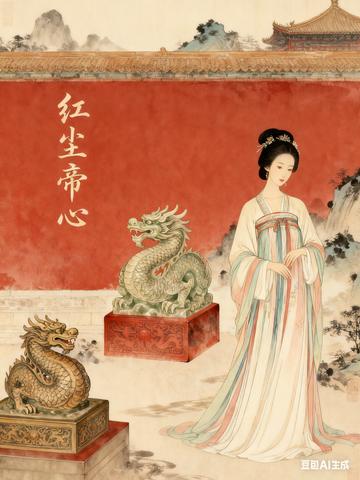
The Heart of the Mortal World traces the rise and fall of the Great Liang dynasty through the legendary life of Cui Wan’er, a famed courtesan who rises from the depths of misery to the pinnacle of power, only to fade into obscurity as the dynasty collapses.
During the peaceful years of Great Liang, Cui Shen, a vice minister in the Ministry of Rites, is framed and his entire family is exiled. His infant daughter, Cui Wan’er, is rescued by a loyal servant and taken to the Jiangnan entertainment quarter, the Misty Rain Pavilion. Under the tutelage of her mentor Su Yuniang, she follows the example of Li Shishi, who was famed for “selling her art, not her body.” Her musical skill and talent make her famous throughout Jiangnan, but one performance of “Lament for the Frontier Dust” catches the attention of Prince Xiao Yu, traveling incognito. This story is entirely fictional.
After coming of age, Cui Wan’er makes her way to the capital and performs songs at the Drunken Immortal House to criticize the state of affairs. There she encounters Xiao Yu again, now enfeoffed as Prince Duan. Caught in a political maelstrom stirred up by powerful ministers, she becomes a pawn in their struggle, much like Chen Yuanyuan. Yet with her wit, she helps Xiao Yu foil their schemes and ascend the throne. Xiao Yu defies all opposition and makes her empress. Cui Wan’er presents him with “Ten Strategies for Ruling the Realm,” hoping to restore the dynasty’s golden age, but Xiao Yu gradually gives himself over to pleasure. As border troubles mount and factional strife intensifies, she is denounced for “interfering in state affairs” and left without support.
In the tenth year of the Jinghe era, an enemy nation invades. Cui Wan’er stops Xiao Yu from fleeing and offers to negotiate, only to be taken captive. By the time she returns, Great Liang has fallen and Xiao Yu has died of illness. In the end, she gathers the emperor’s bones and retires to Jiangnan, where she writes “Lament for the Mortal World,” recounting the dynasty’s rise and fall and her own turbulent life. The enduring debate over whether she possessed more integrity than Li Shishi and more courage than Chen Yuanyuan makes her a vivid testament to an age in decline.