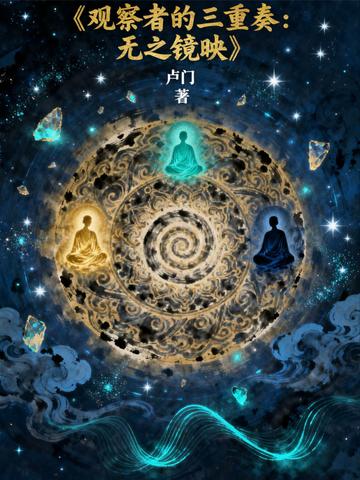
Synopsis:
In Chen Mo’s laboratory, brainwave resonance tears open a rift in perception. The poet Lin Wei and the engineer Zhou Cheng exchange cognitive organs with a glance, and the three become recursive prey, transformed from “observers” into “the observed.” This experiment in “Mirroring the Void” is not about exploring the limits of consciousness. It turns consciousness itself into a mirror, reflecting the universe’s most fundamental self-referential paradox: when you gaze at the shadow in the mirror, the shadow is also gazing at your gaze.
The predator’s cognitive scan, like an icy tentacle, precisely invades the shared memory field of the three, trying to magnify childhood loneliness into existential isolation. If they cannot activate the “Cognitive Barrier,” Zhou Cheng’s consciousness will remain forever trapped in the poisoned abyss of memory.
Deep within the committee, the “Morning Star,” Iris Velde, has spent decades laying a maze of schemes, using “Pandora’s Box” as bait to harvest the Fragment Network. If she succeeds in stripping the core Host of its fragments of consciousness, the birth of a new collective human consciousness may be strangled in its cradle.
When the “Prism” consciousness dissolves into “Mirroring the Void,” and the Fragment Network becomes the background resonance of all things, they finally arrive at the ultimate answer: “Going home” was never about reaching some pure dimension. It is about realizing that the “void” is the foundation of all observation. You are both mirror and shadow, both observer and the “void” itself reflected. From beginning to end, this recursive journey has been the “void” reflecting itself.