[Transmigration and Rebirth + System Story + Officialdom Comeback + Lie-Flat Comeback + Hilarious Commentary + Everyday Livelihoods + Business and Political Schemes]
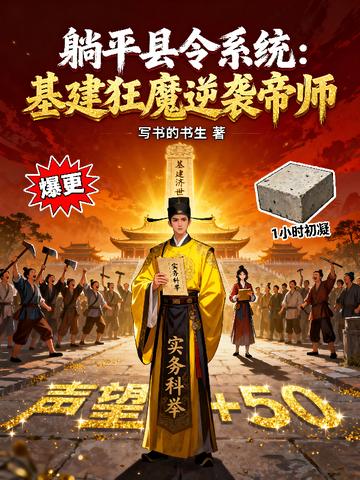
Fang Zheng, a modern infrastructure engineer who just wants to lie flat, opens his eyes to find himself transmigrated into the ninth-rank magistrate of a remote, impoverished county in the Great Jing dynasty. He’s hiding in a woodshed and gnawing on cold steamed buns when refugees surround his door. Then the System binds him to a “livelihood infrastructure” mission: if he doesn’t build an irrigation canal within three days, he’ll starve to death!
From the start, the old carpenter Zhao Liu smashes a concrete test block and scoffs, “How’s a lump of mud supposed to hold back water?” Then a noble clan’s steward tries to bribe him and spread rumors, while grain merchants jack up prices and drive disaster victims to the brink. Forced to toss aside his dream of lying flat, Fang Zheng becomes an “infrastructure foreman,” armed with a plant-ash cement formula. Mixing the cement leaves his throat raw, testing quick-setting concrete tears up his hands, and even modifying a hoe gives him three blood blisters. But the refugees go from “chewing tree bark” to “pickling potatoes and stocking three jars of them.”
Then there’s Li Qingyao, a merchant’s daughter who turns the tables on grain tyrants with her ledgers; Zhuoma, a grassland girl who weaves sand-control nets to protect the canal; and even the Crown Prince chasing after him to plead, “Sir, teach me how to make a splash-proof toilet!” From digging canals to save people from famine to building post roads linking five counties, from adding practical subjects to the imperial examinations to using infrastructure to repel vassal troops, Fang Zheng takes on the noble clans with his “technical trial-and-error manual” and “livelihood ledger.” He turns the poor county into an “infrastructure showcase” and rises from a ninth-rank magistrate to the Emperor’s mentor.
“Fast-paced conflicts + vivid technical details + the warmth of everyday life.” Whether it’s being framed with plague charms during canal construction, disputes over mortise-and-tenon joints on the post road, or cheating by changing exam questions, every chapter brings a crisis and every section delivers results. He uses plant ash to take fingerprints and pounds the ledger to produce hard evidence of 3,000 shi in grain. Even the Emperor praises him: “This dried potato is more satisfying than the Imperial Kitchen’s pastries.” It’s both a hard-core infrastructure power fantasy and a down-to-earth work-comedy, perfect for binge-reading and adaptation into a short-form drama!
 The Bankrupt Boss's Tongue-In-Cheek Counterattack
 Take Your Time
 My Figurines Livestream My Embarrassing Past on Bilibili
 Qin's Grand Strategy: The Iron-Blooded Road to Unification
 A Child Tops the Exams: The Literary Star Refuses to Be a Pawn of the Emperor
 I Transmigrated Into a Spoiled Female Cannon Fodder in the Top-Tier Star’s School Hunk Story
 Blood-Feeding Spirit Plants: I Became the Withered God’s Harbinger of Doom
 Stardust Engine: From Mars to the Top of the Universe
 Monster Hunter: Wilds Crossworld Hunting Grounds