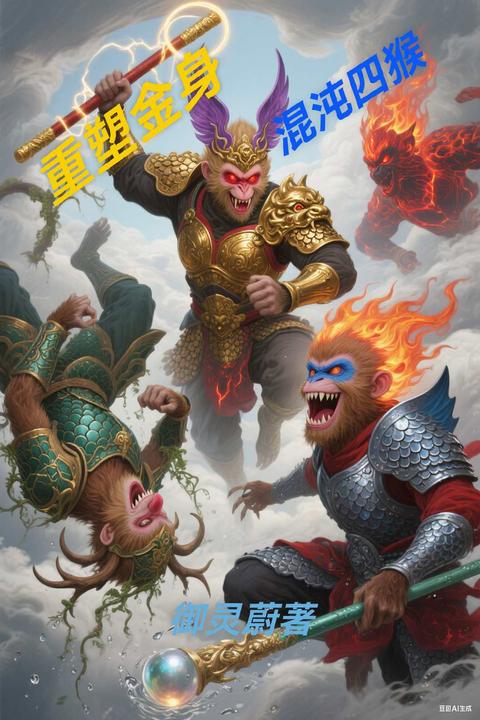
Using Journey to the West as its source material, this work adopts a chaptered, episodic structure and focuses on composite characters that blend Taoism and Buddhism. It draws on Taoist ideas of the Five Elements, the three souls and six spirits, and immortal cultivation, alongside Buddhism's greed, caution, and delusion. Its character-reimagining strategy brings together two storylines and six core elements, deepening the central idea of “cultivating the heart to attain the Dao.” The Four Monkeys' conflict is, at its core, a struggle between human desire and the laws of destiny. No matter whether the story begins with the character of Metal, Wood, Water, or Fire, only by balancing the Five Elements through restraint, transformation, and mutual coexistence, and resisting the temptations of greed, caution, and delusion, can one make progress. Six-Eared Macaque, the rebel; Jing River Dragon King, the lawbreaker; Great Immortal Huli, the corrupt official; Golden-Winged Great Peng, the killer; White Bone Spirit, the schemer; and Little Drill Wind, the traitor, are joined by figures representing benevolence, righteousness, propriety, wisdom, and trust in the Three Realms, as well as freedom, universal love, equality, and democracy. The ethical rules governing friendship, romantic love, and family bonds are also reshaped. All of this is a cultivation trial devised by the Tathagata and the Old Lord for the Four Chaos Monkeys, intended to restore order to the chaos of the Three Realms. Only then can they reach the ultimate state of the Great Sage Equal to Heaven, when the mind-monkey returns to the right path. The story preserves the original's mythic power while offering insights into modern ecological and technological ethics, ultimately creating a system of “balance” that both honors tradition and overturns it.