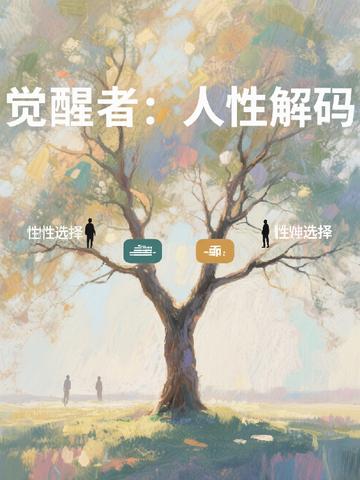
Lin Jue wears the outward trappings of “success,” yet feels torn apart by the hypocrisy on display at the annual gala. In the power games of the conference room, he feels the jagged edges of the truth, only to end up trapped in the mire of his own perceptions.
A question from his college friend Su Ming, “Is human nature something to deconstruct or rebuild?” pries open a crack in his deadlock. CEO Zhou Siyuan’s schemes reveal the complex logic of survival among the strong; psychologist Xia Wei’s professional lens refracts the abyss within him; and the code philosophy of Chen Mo, a low-level programmer, lays bare the simple algorithms governing human relationships. So Lin Jue sets out on a “field study” of human nature: listening to strangers cry on the subway, facing the generational divide in family arguments, weighing power and responsibility amid a data-leak scandal, and glimpsing the authentic self beneath anonymity on social media.
This is no awakening of superpowers, but a revolution in perception: using empathy to dismantle prejudice and systems thinking to break through constraints. Across 220 slices of human nature, he gradually comes to understand that a higher-dimensional perspective is never the arrogance of looking down on everyone else. It means seeing the rules clearly and still holding fast to your principles. Human nature is not a black-and-white question with a single right answer, but a prism of countless hues, something to decode rather than judge.
As hypocrisy and sincerity, survival and ideals clash before him, Lin Jue finally understands: awakening is simply finding the courage, after recognizing the shades of gray in human nature, to write a new algorithm for life, moving from merely “being alive” to truly “living fully,” and from “being defined” to “defining yourself.”