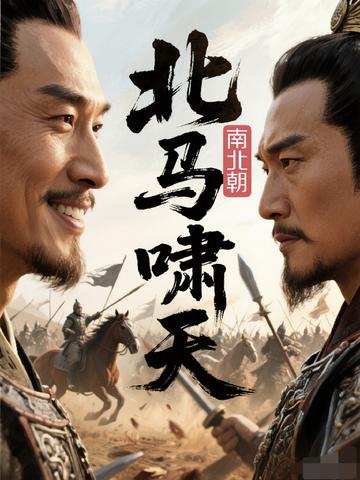
In the final years of the Northern Wei, the flames of war across the Six Garrisons tore the empire apart. Two heroes rose from the crucible of blood and fire:
Gao Huan, a poor scholar from Huaishuo, was bold and unrestrained as a wild horse. He rose with the help of Erzhu Rong and the Xianbei, only to become ensnared in the vortex of power. Keenly aware of human weakness, he could be both deeply devoted and utterly ruthless. With his wife Lou Zhaojun’s warning, “Wolves eat meat, while lambs nibble grass,” and her iron-fisted support, he carved out Eastern Wei amid the chaos and was enfeoffed as Prince of Bohai. The oath sworn beneath the walls of Yubi and the fury of revenge at Mangshan could not spare him a hero’s tragic end. All that remained was the regret that he had “never seen Luoyang’s peonies together with her.”
Yuwen Tai, a soldier from Wuchuan, was as disciplined as ice. The scars of war gave him a “fear of laughter,” and forged a will of steel. Holding fast to the ideal of “reviving the rites of Zhou and creating a common good,” he united the Guanzhong clans through reforms to the fubing system and founded Western Wei to stand against Gao Huan. At the reeds of Shawan, flames consumed two hundred thousand enemy troops: a calculated sacrifice of pieces in his cold game of strategy. When he quietly whispered, “May we see the flowers in Chang’an together,” as he braided his wife’s hair late at night, it revealed the sole tenderness beneath his iron exterior. He planted mulberry trees with his own hands as a symbol of his new policies, yet even he could not withstand the tide of the times.
The two heroes contended across the Yellow River: the inferno at Shawan, the bloodshed at Hegu, the fierce battle at Mangshan, the impregnable fortress of Yubi… Every clash reshaped the map of the north. Amid schemes and clashing blades, Lou Zhaojun held her ground in Jinyang through her wisdom and balanced the Xianbei and Han; Princess Fengyi melted the ice with her warmth; and Yang Jian quietly gathered strength in the shadow of his forebears, until he became the player who would claim the realm.
This is no simple change of dynasties. It is a brutal clash between idealism, embodied by Yuwen Tai’s vision of the Zhou rites and common good, and reality, embodied by Yang Jian’s centralized empire. It is a fierce collision of Xianbei and Han cultures, and an epic in which heroes and their age shaped one another.