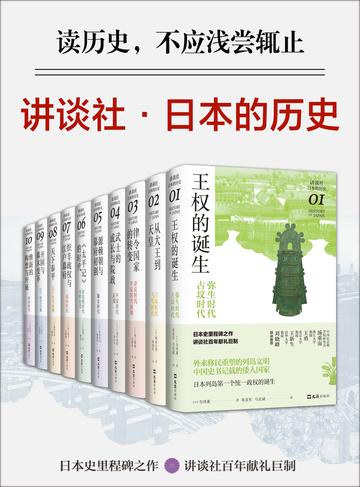
★ A landmark work in Japanese history, published as a grand centennial tribute by Kodansha. A heartfelt work by Japanese historians for general readers.
★ Led by the eminent Japanese historian Amino Yoshihiko and written by ten leading Japanese scholars, with translations by ten rising scholars. Open-minded, objective, and international in scope, this series brings together forty years of research and represents the cutting edge of Japanese historiography. It is an authentic history of Japan unlike any published before.
★ Understand Japanese history with one series. This set contains 10 volumes, 4,112 pages, and 2 million Chinese characters, covering key events and periods in the more than 2,000 years during which Japan developed from tribal communities into a modern nation: from the arrival of rice cultivation and the birth of royal power, to the establishment of the imperial system and the rise of the regent system; from the emergence of the samurai class and the division between the Northern and Southern Courts, to the warring states and the unification of Japan under the Edo shogunate, followed by the Meiji Restoration and the establishment of a modern nation. Viewed in the context of East Asia and the wider world, this series helps us gain a deeper understanding of Japan today, as well as East Asia and the world.
★ Each volume is organized around a key question, with Japanese historians examining their own history from within. The series offers both a sweeping grasp of the broader historical picture and close attention to individual details. Written with scholarly authority, yet highly accessible and engaging, it is intended for general readers.
★ Recommended by renowned historians Tang Chongnan, Wang Yong, Wang Xinsheng, and Liu Xiaofeng: “For Japanese history, this is the only series you need.”
Kodansha’s “The History of Japan” consists of 10 volumes, 4,112 pages, and 2 million Chinese characters, presenting 2,000 years of Japanese history.
From the arrival of rice cultivation and the birth of royal power, to the establishment of an unbroken imperial system and the rise of the regent system; from the transition from a state governed by codes and statutes to a court-centered state, to the Genpei War, the division between the Northern and Southern Courts, the struggle among rival warlords, and the unification of the realm. Then came an age of tremendous change: the arrival of the Black Ships, the movement to revere the emperor and expel the barbarians, and, amid mass popular movements, the Meiji Restoration and the founding of a modern nation.
Written by ten leading Japanese scholars and translated by ten rising Chinese scholars, the series is organized into themed volumes, each anchored by a key question. It combines rigorous historical scholarship with vivid storytelling, close attention to individual lives with a broad understanding of the archipelago in each period. A substantial and detailed classic of history, it draws on multiple disciplines and offers fresh perspectives.