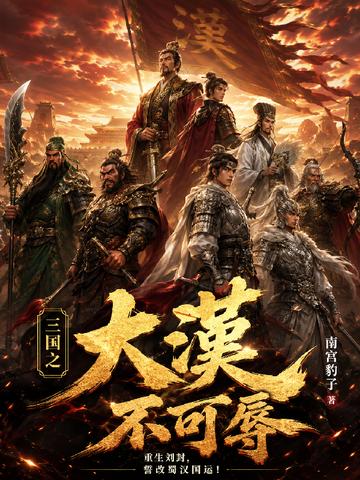
Three Kingdoms: The Great Han Must Not Be Insulted
三国之大汉不可辱
- Status
- Ongoing
- Length
- 759k Words
- Genre
- Historical
- Subgenre
- Historical & Ancient
- Updated
- 4d ago
- Source
- Fanqie
Stats
246Chapters
120Reads
8.4Score
77Listens
4kReads · all time
Tags
Synopsis
In booklists 5



Stories With a Female Lead Who's Humble to the Core
The male lead never hits or scolds the female lead. He just doesn’t like her, but she still likes him carefully and timidly.
420Books9.7MViews2dUpdated
Looking for Recommendations for the Ten Greatest Three Kingdoms Novels
304Books2.7MViews7dUpdated




Please, Are There Any Gravity Falls Fanfics? (>﹏<)
15Books76.4kViews11dUpdated
I'm Out of Books to Read! Looking for Three Kingdoms Stories!
I'm looking for something like *Is Being Too Charming a Mistake? Even Cao Cao Became a Fanboy*. Recommend some new Three Kingdoms stories from the past year!
11Books21.9kViews3moUpdated

I’m in a Reading Slump. Book Recommendations, Please
I want something like *I Picked Up a Merman, and He Wants to Come Home with Me*. Any women who have been reading for over ten years have recommendations? I'm looking for female-oriented romance.
94Books8.3kViews4moUpdated
Reader comments 83
Google Translate
The most eye-catching setting in the novel is the dual identity of the protagonist Liu Feng - the son of a cricket who carries the soul of Liu Chen, the king of the North. Liu Feng is a regrettable figure in the official history who was sentenced to death by Liu Bei for not saving Guan Yu and defecting out of fear of crime. Liu Chen is a loyal prince who cried in the temple and died for his country when the Shu Han Dynasty was destroyed. The two souls merged, making the protagonist bear a double fate from the beginning: not only to atone for his cowardice and choices in his previous life, but also to make up for the overthrow of the Han Dynasty. This setting breaks out of the common "brainless and cool" framework of the Three Kingdoms novels, making every action of the protagonist carry a redemptive undertone, and also gives the theme of "a man cannot be humiliated" an emotional support that touches people's hearts.
This work unfolds with a unique setting: After Liu Chen, the fifth prince of the Shu Han Dynasty, died for his country, his soul traveled decades ago and was reincarnated as Liu Bei's adopted son Liu Feng. From then on, he carried the memories of his previous life and tried his best to assist his father Liu Bei Kuang in supporting the Han Dynasty. Liu Bei relied on the strategy of "Longzhong Du" to control the complete Jingzhou and Yizhou, and his strength far exceeded that of the same period in history. After the Battle of Chibi, Cao Cao still dominated the north; Sun Quan firmly controlled Yang and Jiaozhou, tolerated development, and became one of the top three in the world. The plot has climaxes one after another: Guan Yu wields his troops across the Central Plains and is powerful in the Central Plains; Liu Bei's Northern Expedition to Chang'an finally realizes his long-cherished wish; the five tiger generals and the five good generals have a hearty battle on the battlefield; Sun Quan also defeats Hefei and is full of high spirits. The three companies each have their own progress, and together they build a truly powerful force, creating a magnificent legend of hegemony that subverts history.
The core charm of this book lies in the ingenuity of character setting and the empathy of the theme of supporting Han. The protagonist Liu Feng is no longer the regretful figure who was sentenced to death due to suspicion in the official history. Liu Chen's loyal soul has infused him with the blood and bones of "I would rather die than surrender, and swear to protect the Han Dynasty." His past mistakes have become his obsession, and future memories have become his weapons. This dual setting of "atonement + restoration of the country" gives the character's behavioral logic a solid support, and makes "supporting the Han" no longer an empty slogan, but an obsession hidden in every word and deed. From making up for one's own shortcomings to assisting Liu Bei in restoring the country, the protagonist's growth line is intertwined with the revival line of the Han Dynasty, allowing readers to feel a trace of regret for the end of the Han Dynasty and expectations for revival in the pleasure of refreshing writing.
This is a thrilling masterpiece about the rebirth of the Three Kingdoms! The author uses the writing style of Nangong Baozi to skillfully integrate the souls of Liu Feng and Liu Chen, allowing the protagonists who are burdened with historical regrets to return to the troubled times of the late Han Dynasty with future memories. Not only did he want to atone for his choices back then, but he also wanted to use Liu Chen's loyal heart to assist Liu Bei in turning the tide and rebuilding the glory of the Han Dynasty. The book contains both the warriors of the battlefield and the turbulent plots of the court. While the protagonist makes up for past regrets, it also allows readers to see a different path to the rise of the Shu Han. It can be called a potential dark horse in the history of the Three Kingdoms!
Not bad, nice looking. The most wonderful setting of this work is to use Liu Feng as the anchor to reconstruct the fate of Shu Han. The soul of Liu Chen, the fifth prince of the Shu Han Dynasty, returned to Liu Feng after he died for his country. This time-travel with a hundred years of memory is no longer a bystander's watch, but a breakthrough for those who have experienced it. Liu Bei has a complete Jingyi and a strength far beyond the historical setting, and instantly has soul support. Unlike most Three Kingdoms novels that focus on the main characters, this book unfolds a battle for hegemony intertwined with emotions and logic from Liu Feng's perspective. Guan Yu's command of his troops, Liu Bei's Northern Expedition, and the duel between the Five Tigers and the Five Sons. These classic scenes are no longer isolated passionate scenes, but the inevitable result of Liu Feng's memory layout from his previous life and the righteousness of the Han Dynasty. Sun Quan's high-spirited victory over Hefei, and the checks and balances of Cao, Sun, and Liu were all promoted step by step in Liu Feng's planning, making the game of the Three Kingdoms more three-dimensional. The characterization of the characters in the book jumps out of facial expressions: Liu Bei is no longer a simple benevolent king, but weighs the fetters with his adopted son; Liu Feng does not blindly change his fate against nature, and every decision he makes hides compensation for historical regrets and sincerity to the Han Dynasty. The ups and downs of the plot include the excitement of a battlefield duel and the delicacy of the power game. It not only fulfills the long-cherished wish of readers of Shuhan Zhongxing, but also uses a unique perspective to make this legend that subverts history a heart-stirring elegy for the Han Dynasty.
When I first read it, I thought it was just another old-fashioned time-travel novel - the system is added and plug-ins are rampant, but after reading it, I discovered that there is a whole new world. The story tells that after Liu Chen, the king of the northern Shu Han Dynasty, died for his country, his soul actually traveled to Kou Feng who was more than 40 years ago and was reborn. Kou Feng has a special bloodline: his mother is a princess of the Han Dynasty, his father comes from the line of founding heroes, and he is considered an adopted son by Liu Bei. His life experience can be said to be a combination of coincidence and destiny. Liu Chen, who carries the memories of his previous life, sincerely assists Liu Bei in this capacity, using his foresight to help him support the Han Dynasty and make up for many regrets in history - the tragedy of Yiling can be avoided, Jingzhou may no longer change hands, and Ji Han's fate has quietly changed. This kind of writing method based on historical facts and boldly reconstructed has both profound heritage and smooth narrative. It is indeed an eye-catching masterpiece on the theme of the Three Kingdoms. [Praise]
5-Star review. Very interesting. I think it's worth reading. If you don't read it, you will regret it for the rest of your life. It's very interesting. It's a novel novel. You can definitely read it. This is a work that stayed up late to catch up on updates. The author's imagination is wide-ranging and the characters are described with vivid scenes and details. Breaking through the traditional framework, the main and branch characters are clearly and vividly created, and the concept of the structure from the small self to the big self has jumped up. This book made me immersed in it. The plot had ups and downs and the characters were vividly drawn, as if they were vividly written on the page. It not only brought me endless imagination, but also gave me profound insights. Every page is full of surprises and is worth reading again and again. It is a five-star review and highly recommended!
As a derivative of Three Kingdoms fan fiction, this book is very interesting. Liu Chen was reborn as Liu Feng, with regret for the fate of Shu Han, and changed the direction of history step by step. The author writes the details of Jingzhou's management and the Northern Expedition very solidly, with both a sense of history and a refreshing rhythm. The new situation of the three contending families is full of variables, and every battle on the battlefield is interesting to watch.
This is a Three Kingdoms novel of burning desire, difficult redemption, and rebirth. The protagonist returns with the soul of Liu Chen, the king of the North, and returns to the troubled times of the late Han Dynasty with the perspective of future generations and full of regret. The pain of the collapse of the Shu Han Dynasty and the destruction of the country and family in the previous life is engraved in the bones and blood. In this life, he is no longer the last king and grandson who is unable to recover, but a game-breaker who holds the memory of the future and works step by step. He has a thorough understanding of the general trend of the world and recognizes all heroes and mediocre people. To make up for Mr. Liu's regrets during his lifetime and to avoid the previous disasters of the Shu Han Dynasty, Turn the tide before it falls, and support the building before it collapses. From political intrigues to decisive battles on the battlefield, from employing people to make decisions to governing the country in an orderly manner, He uses his prophet as his blade and his loyal soul as his bones, Step by step, correct the forks in history and heal the regrets of our predecessors. Not for hegemony, just to honor the great man; Not for vain fame, but to live up to the late master and the common people.
"The Great Man of the Three Kingdoms Cannot Be Insulted" is a masterpiece of historical rebirth that crushes and reshapes the Three Kingdoms. It uses the unique setting of Liu Feng, the son of a dragonfly, and the loyal soul of Liu Chen. The Shu Han clan, which unfortunately came to an end in the official history, bucks the trend with future memories and obsession with serving the country, and sets off a desperate counterattack belonging to the great Han in the flames of war. It is full of passion and pleasure to read. Very exciting and worth recommending.