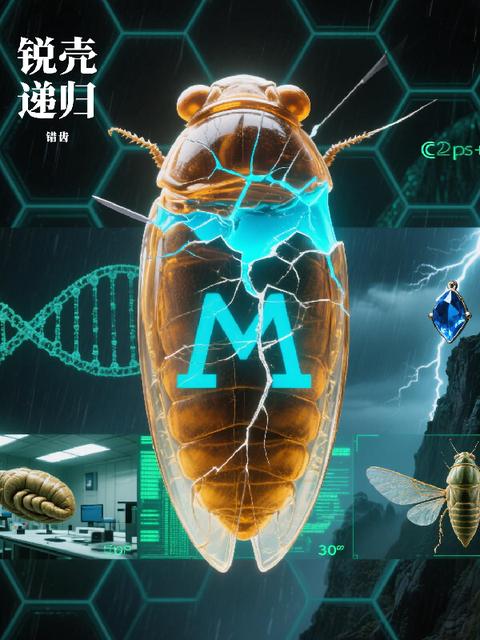
A string of murders erupts in the near-future city of Wugang. Every victim wears a single blue sapphire earring, and the organs at their wounds have mysteriously regenerated. Forensic entomologist Jiang Yufeng detects a supposedly extinct cloning enzyme in the abdomen of a red imported fire ant found inside a corpse sealed in concrete. Criminal profiler Bai Yilin discovers butterfly scales on the murder weapon, the same kind that led to Jiang Yufeng's younger sister falling off a cliff three years ago.
When Jiang Yufeng uses her bionic eye to decipher a quantum code hidden in a corpse's earlobe, she is horrified to discover that every victim's DNA perfectly matches her own. They are clones at different stages of development. The killer has arranged a "Twelve Houses of Insect Molting" puzzle in the corpses, ordered by Greek letters: each body is both evidence of a crime and a cocoon incubating the next killer. Even more terrifying, a half-melted piece of amber left at the crime scene contains a holographic image of Jiang Yufeng "killing" her sister, Lin Chan.
As the investigation deepens, the two discover that the sapphire earrings are actually consciousness transmitters, and that the victims are all iterations of the "Mirror Killer Project." When Bai Yilin's synesthesia breaks through four-dimensional spacetime, the truth tears through the web of memories like a poisonous spider: Jiang Yufeng is the first clone to successfully molt, and all the murders are a self-destruct sequence she triggered to prevent her original self from awakening.
This novel pioneers the concept of "biological recursive crime," fusing insect metamorphosis with quantum entanglement theory. When the thirteenth corpse breaks out of its cocoon in a circular laboratory, Jiang Yufeng has no choice but to plunge a scalpel into her own carotid artery, because the only killer who can end the time loop is herself, before she has committed the crime.