Comprehensive Mirror to Aid in Government: The Everlasting Theater of Human Nature
When modern people recreate the schemes of the Xuanwu Gate Incident in boardrooms and replay the Chu-Han Contention during investor pitches, the Comprehensive Mirror to Aid in Government has already written the answer. Sima Guang wielded history like a blade, laying bare 1,362 years of human nature: An Lushan's path of flattery and opportunism is just like today's workplace climbers who specialize in “managing upward”; Fu Jian's arrogance before the Battle of Fei River, trusting in his million-strong army, resembles decision-makers in the big-data age trapped in “filter bubbles.” The book's sharpest insight is its exposure of the same script behind the drama of every age: the ironclad triangle of power, desire, and fear.
Its record of more than thirty failed reforms forms a white paper on ancient social experiments. The backlash from vested interests that doomed Shang Yang's reforms shares the same roots as the organizational growing pains of tech companies undergoing transformation. Emperor Wu of Han's ingenious policy of granting fiefs to the princes' heirs, which weakened the vassal lords, still lives on in modern equity design. When Emperor Taizong's crisis management at the Weishui Alliance becomes an MBA case study, and the factional infighting of the Niu-Li Factional Strife turns into a textbook on capital warfare, this thousand-year-old history book completes its transformation from dusty pages to a real-world sandbox.
History has never taught people how to succeed, but it always shows them how to avoid repeating past mistakes. Open this magic mirror that reflects past and present, and you'll be startled to discover that beneath every grand-sounding ideology, the same naked pulse of human nature beats. And that is the survival algorithm the Comprehensive Mirror to Aid in Government offers every modern reader.
"Game of Thrones: The Black History in Zizhi Tongjian" published in the summer solstice takes a new approach and interprets "Zi Zhi Tongjian" from a unique perspective, which is refreshing. It breaks through the traditional historical narrative model and connects classic events such as the division of the three families into the Jin Dynasty and the Battle of Changping with modern scenes, making the obscure history vivid and easy to understand. During the narration process, the author portrays the characters in detail, such as Zhiyao's willfulness and King Zhao Wuling's talents and strategies, all of them are lifelike, allowing readers to deeply feel the complexity and multifacetedness of historical figures. Digging deeply into the power, desire and fear behind historical events is the essence of this book. It reveals that history is not a simple list of events, but the result of the competition between various forces. The Battle of Changping was not just Zhao Kuo's "paper talk", but also underlying factors such as Zhao's strategic decision-making errors and diplomatic isolation. Reading this book feels like being in the whirlpool of ancient power struggles. It can not only enrich historical knowledge, but also provide reference for the present. Whether it is dealing with people or facing competition, one can learn wisdom from it.
Nice. This is the first time I read Zizhi Tongjian, and it turns out that it is so rich in content.
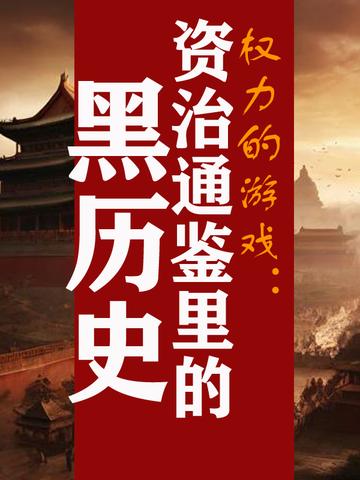


"Game of Thrones: The Black History in Zizhi Tongjian" published in the summer solstice takes a new approach and interprets "Zi Zhi Tongjian" from a unique perspective, which is refreshing. It breaks through the traditional historical narrative model and connects classic events such as the division of the three families into the Jin Dynasty and the Battle of Changping with modern scenes, making the obscure history vivid and easy to understand. During the narration process, the author portrays the characters in detail, such as Zhiyao's willfulness and King Zhao Wuling's talents and strategies, all of them are lifelike, allowing readers to deeply feel the complexity and multifacetedness of historical figures. Digging deeply into the power, desire and fear behind historical events is the essence of this book. It reveals that history is not a simple list of events, but the result of the competition between various forces. The Battle of Changping was not just Zhao Kuo's "paper talk", but also underlying factors such as Zhao's strategic decision-making errors and diplomatic isolation. Reading this book feels like being in the whirlpool of ancient power struggles. It can not only enrich historical knowledge, but also provide reference for the present. Whether it is dealing with people or facing competition, one can learn wisdom from it.
Nice. This is the first time I read Zizhi Tongjian, and it turns out that it is so rich in content.