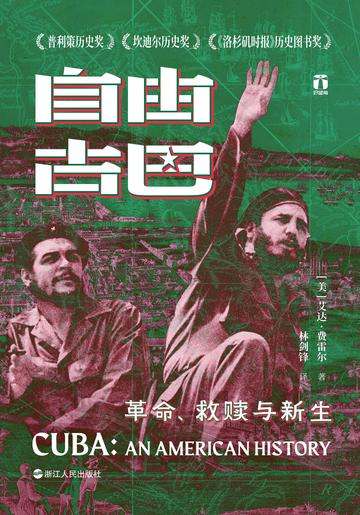
It has successively won the Pulitzer Prize for History, the Los Angeles Times History Book Award, and has been recommended by many Pulitzer Prize winners. It has also been recommended by many well-known media outlets such as The Economist, Kirkus Reviews, The Wall Street Journal, and The Guardian;
This is one of the few general histories of Cuba in the country, a comprehensive work by Cuban historians, and tells the history of Cuba spanning five centuries. Its breadth and richness of content are unmatched by other Cuban historical works. In addition, it breaks away from the traditional heroic narrative and tells the story of the Cubans in prose-like style. It is an epic and authoritative work of Cuban history.
It is not only an epic history of Cuba, but also a history of the relationship between the United States and Cuba, telling the intractable entanglements between the two countries for hundreds of years. Cuba is the largest island in the Caribbean and one of the first lands that Columbus set foot on during his first voyage to the Americas in 1492. The rich soil and water here, coupled with the shiploads of African slaves, made Cuba the jewel in the crown of the Spanish Empire, bringing a steady stream of sugar, coffee and tobacco to Europe. However, behind the wealth is the sweat and blood of countless indigenous people and black slaves. Therefore, from the beginning, the pursuit of freedom and racial liberation has become the main thread throughout Cuban history.
With the Spanish-American War at the end of the 19th century, the Spanish colonists retired sadly, but the newly born Republic of Cuba (1902-1959) was quickly controlled by the United States and became the spoils of the latter's foreign expansion policy. It had to start a new round of struggle for independence and freedom. In 1959, the Cuban revolution led by Castro succeeded, and Cubans finally established the independent country they had longed for. The United States, this dangerous and powerful neighbor, has never taken its eyes off Cuba.
In fact, this five-century history of Cuba is not only a history of the Cuban people's pursuit of freedom and liberation, but also a history of slavery, sugar industrial parks, colonialism and national revolution. It is also a history of the intricate relationship between Cuba and the United States. By reading up close the development of Cuba, we will witness her glorious history from conquest and slavery to freedom and independence. The mirror of Cuba also reflects the process of the United States gradually gaining world hegemony over the past 100 years.
It is worth mentioning that this book never limits its perspective to individual great figures. Those who sewed under the faint fluorescent light of the slave cabins, those who took up arms in the revolution, those who did not leave their names in official history, are the real protagonists of Cuban history.
Reader comments
A very interesting book. Cuba made a great attempt.





A very interesting book. Cuba made a great attempt.