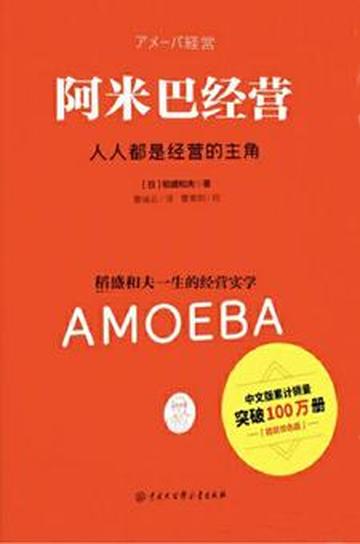
The amoeba business model is known as "one of the two pillars of Kyocera's business success." This book explains in detail the operating methods of amoeba management, and summarizes Inamori Kazuo's business views and practical experience. It is a book for learning amoeba management.
Amoeba management is based on a solid business philosophy and sophisticated departmental independent accounting management. The enterprise is divided into "small groups", like an amoeba that freely and repeatedly undergos cell division. With each amoeba as the core, it makes its own plans, conducts independent accounting, and continues to grow independently. It allows every employee to become the protagonist, and all employees participate in the operation to create a passionate collective that relies on the wisdom and efforts of all to complete the business goals and achieve rapid development of the enterprise.
More than 500 companies around the world have introduced the amoeba business model, and their performance has been significantly improved.
Reader comments
Mr. Daomori works hard and uses his own experience to tell what is correct in managing an enterprise? Continuous learning, continuous practice, continuous thinking, continuous summary, and continuous practice, to make his own contribution to the happiness of employees and the development of the country and society. Contribute, not seek selfish interests, devote yourself to work wholeheartedly, know the choice, persist and continue to work hard, write good management philosophy into books, establish Shengwa Juku, establish the Kyoto Prize, and leave precious spiritual wealth for the world, the country, and the world.
Nowadays, some people lack spiritual food and suffer from daily anxiety, worry, and pain. They constantly consume themselves internally, harm others for their own selfishness, do illegal things, and do things that are harmful to the people, society, and the country. They always want to make a fortune, but lack the actions to do practical things. They think they are strong on the outside, but in fact they are weak on the inside.
People can still move forward despite hardships and pain, and they will eventually gain something. Don't always focus on the little things in front of you, worry about it, and don't understand anything. You don't want to do this, you don't want to do that, you complain that the work is too hard, you complain about the people around you, you complain about the company's downturn, you complain about the boss treating his employees like a bullshit. Horse, when something happens, change your mind, change your thoughts, and look at the problem from another angle. Maybe you will be able to suddenly understand, learn to make reasonable explanations, learn how to deal with things, learn to think from others' perspective, learn to grow in adversity, and learn more useful knowledge. We can't make money beyond our knowledge. We should learn to communicate with others and learn more. The strengths of others make up for your own shortcomings. Don't let small achievements contaminate yourself. When others praise you, you will feel that you are not good enough. You must be good at discovering your own strengths and analyzing your own strengths and weaknesses. Don't internalize yourself. Do what you can do. Let the rest take its course. Don't always do it. Let's blame everyone. People who are better than us are still learning and working hard. Don't always learn things with half-knowledge or not settle down to learn. After learning for a while, you don't want to learn. Once you learn, you have to think about using it. We are all ordinary people. If you are determined to change, don't give up easily halfway.
Happiness is in our hands. We must do our jobs well, work hard to develop skills, and persist and persist. Only when we are alive can we have hope, and only when we are alive can we have everything.
The amoeba business model mentioned in the book, which divides enterprises into small groups, can fully mobilize the enthusiasm of employees and make everyone a protagonist. I particularly like this business philosophy of full participation, which feels very dynamic and creative. Moreover, the practical experience in the book is also very practical and helpful for improving performance.

Mr. Daomori works hard and uses his own experience to tell what is correct in managing an enterprise? Continuous learning, continuous practice, continuous thinking, continuous summary, and continuous practice, to make his own contribution to the happiness of employees and the development of the country and society. Contribute, not seek selfish interests, devote yourself to work wholeheartedly, know the choice, persist and continue to work hard, write good management philosophy into books, establish Shengwa Juku, establish the Kyoto Prize, and leave precious spiritual wealth for the world, the country, and the world. Nowadays, some people lack spiritual food and suffer from daily anxiety, worry, and pain. They constantly consume themselves internally, harm others for their own selfishness, do illegal things, and do things that are harmful to the people, society, and the country. They always want to make a fortune, but lack the actions to do practical things. They think they are strong on the outside, but in fact they are weak on the inside. People can still move forward despite hardships and pain, and they will eventually gain something. Don't always focus on the little things in front of you, worry about it, and don't understand anything. You don't want to do this, you don't want to do that, you complain that the work is too hard, you complain about the people around you, you complain about the company's downturn, you complain about the boss treating his employees like a bullshit. Horse, when something happens, change your mind, change your thoughts, and look at the problem from another angle. Maybe you will be able to suddenly understand, learn to make reasonable explanations, learn how to deal with things, learn to think from others' perspective, learn to grow in adversity, and learn more useful knowledge. We can't make money beyond our knowledge. We should learn to communicate with others and learn more. The strengths of others make up for your own shortcomings. Don't let small achievements contaminate yourself. When others praise you, you will feel that you are not good enough. You must be good at discovering your own strengths and analyzing your own strengths and weaknesses. Don't internalize yourself. Do what you can do. Let the rest take its course. Don't always do it. Let's blame everyone. People who are better than us are still learning and working hard. Don't always learn things with half-knowledge or not settle down to learn. After learning for a while, you don't want to learn. Once you learn, you have to think about using it. We are all ordinary people. If you are determined to change, don't give up easily halfway. Happiness is in our hands. We must do our jobs well, work hard to develop skills, and persist and persist. Only when we are alive can we have hope, and only when we are alive can we have everything.
The amoeba business model mentioned in the book, which divides enterprises into small groups, can fully mobilize the enthusiasm of employees and make everyone a protagonist. I particularly like this business philosophy of full participation, which feels very dynamic and creative. Moreover, the practical experience in the book is also very practical and helpful for improving performance.