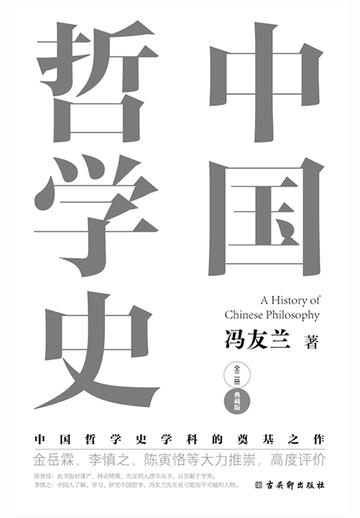
One book tells the complete history of the development of Chinese philosophy: from the Zhouyi and the Tao Te Ching to Wang Yangming, from Confucianism and Taoism to Buddhism. High school reading books, liberal arts college undergraduate books, the most comprehensive and authoritative "Sansongtang" edited by Feng Youlan's son-in-law Cai Zhongde, recommended by Chen Yinke, Jin Yuelin, Li Shenzhi and others.
Reader comments
I'm exhausted from reading it. It's not the same level of difficulty as the history of Western philosophy. It requires some achievements in history and Chinese studies, but also requires dry (not bad, but high in information) narrative classical Chinese texts.
Unlike the history of Western philosophy, which is centered on ontology and theology, the history of Chinese philosophy is more practical and tends to be more "political philosophy" (of course not all of it, to say it is a bit absolute). As a result, the sense of "enlightenment" cannot be reflected in reading the history of philosophy, and the sense of accomplishment is reduced. Of course, if you can read it thoroughly during the Bazixue period, you will find that Chinese philosophy is not in-depth, but has a vague "hazy" feeling. If you can't explain it clearly, you can see for yourself.
This book combs the development history of Chinese philosophy, with rich content and unique perspectives. I just graduated and am looking for a job. Reading this book made me understand that we will always encounter various confusions in life, but philosophy can help us think and deal with them better. Just like a friend of mine, when he faced a career choice, he found his own direction through in-depth thinking and philosophical guidance. This book has benefited me a lot and I recommend it to you!



I'm exhausted from reading it. It's not the same level of difficulty as the history of Western philosophy. It requires some achievements in history and Chinese studies, but also requires dry (not bad, but high in information) narrative classical Chinese texts. Unlike the history of Western philosophy, which is centered on ontology and theology, the history of Chinese philosophy is more practical and tends to be more "political philosophy" (of course not all of it, to say it is a bit absolute). As a result, the sense of "enlightenment" cannot be reflected in reading the history of philosophy, and the sense of accomplishment is reduced. Of course, if you can read it thoroughly during the Bazixue period, you will find that Chinese philosophy is not in-depth, but has a vague "hazy" feeling. If you can't explain it clearly, you can see for yourself.
This book combs the development history of Chinese philosophy, with rich content and unique perspectives. I just graduated and am looking for a job. Reading this book made me understand that we will always encounter various confusions in life, but philosophy can help us think and deal with them better. Just like a friend of mine, when he faced a career choice, he found his own direction through in-depth thinking and philosophical guidance. This book has benefited me a lot and I recommend it to you!