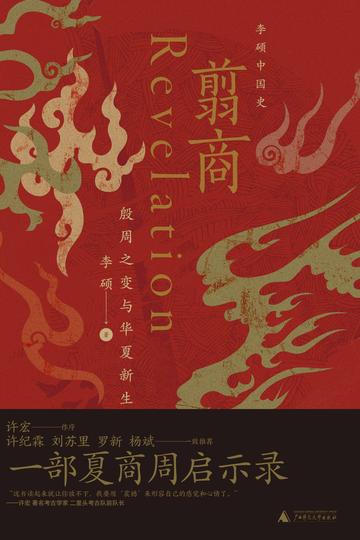
The Conquest of Shang: The Shang-Zhou Transition and the Birth of a New China
翦商:殷周之变与华夏新生
- Status
- Completed
- Length
- 320k Words
- Genre
- Historical
- Subgenre
- Unknown
- Updated
- 2y ago
- Source
- Fanqie
Synopsis
32Chapters
2.4kReads
9.5Score
842Shelves
311Listens
72.1kReads · all time
More by this author
In booklists 4

Books with Depth That Make Me Think
I'm looking for something with solid logic, not a brainless fluffy romance, with major twists and foreshadowing, and an expansive world.
824Books79MViews15hUpdated
Books Every Student Should Read: Essential for Surviving the Rat Race
Math, Chinese, English, chemistry, physics, biology, geography, history, classical poetry...
484Books129.8MViews1dUpdated
World Classics, Literary Greats
620Books3.8MViews1dUpdated
Any New Book Recommendations?
Looking for something like Help! I Called My Boss “Honey”! I’m so bored. Does anyone have any good novel recommendations?
228Books4.5kViews10moUpdated
Reader comments 53
Translated by Google Translate
It looks good, is very readable and easy to understand for an amateur like me. Although the details may be a bit far-fetched, after all, there is indeed not much information on the Shang Dynasty, and overall the flaws are not concealed. This book was my introduction to the Shang Dynasty. The bloody and brutal culture of human sacrifice really opened my eyes and had a great impact. The interpretation of the content into a story is so wonderful. As a metaphysics lover, it is refreshing, and the words suddenly feel like they come alive. For thousands of years, successive fortune tellers in later generations have provided many explanations for the Book of Changes, but they are all far-fetched. This storybook-like explanation is actually the most reasonable. However, the author does not agree with the statement that "Gong Zhou made annotations to cover up his father's original intention", because from a metaphysical perspective, the content of Duke Zhou's annotations is not completely unrelated to the original text. I think Duke Zhou was also studying his father's divination, hoping to get the destiny like his father. (I'm not very skilled, so I'm just guessing.) The coup of Duke Zhou later was also very exciting, but what shocked my soul the most was the last paragraph about Confucius. When the author wrote this, I felt that the image of Confucius in my mind suddenly became more complicated. In the past, I only knew that he foolishly hoped to make the world unified through rules (the fact is that underdeveloped productivity and insufficient materials will never make the world unified). The many complexities make me feel that he is not that stupid. All in all, this is a very good book, thank you to the author!
The first half of the book is much more rigorous than the second half. There are many interpretations of Zhouyi, and the author is just one person. Too many inferences will destroy its reliability. However, the writing method is combined with the novel, which adds a sense of plot to the archaeological popular science book, and it is really enjoyable to read it in one sitting. The shortcomings do not hide the good points, especially for non-professional readers.
It feels very surprising. Although I knew that some people would be sacrificed in ancient times, I did not expect that the phenomenon of human sacrifice during the Shang Dynasty was so developed, and people were sacrificed on a large scale. Another very surprising thing is that the "Book of Changes" was actually written by King Wen of Zhou based on his personal experience. I always thought it was a magic book for divination and fortune-telling [laughing and crying]. I didn't expect that the author could interpret the history of Shang and Zhou Dynasty based on the "Book of Changes". It is very novel, but also well-founded. The Duke of Zhou and Confucius made too many efforts to bury this history of human sacrifice, and secular moral concepts made life seem so precious.
This book is so interesting! It allowed me to understand the sacrificial customs of the ancients, and also how much effort the Zhou people made to end the Shang Dynasty and the custom of human sacrifice. The author Li Shuo is so amazing, and his writing about Confucius is also very innovative! This book is like a time-travel drama, taking me back to ancient times. I think it's a bit like "The Romance of the Three Kingdoms", both about historical changes and heroes. But "Jian Shang" is more mysterious and imaginative. I recommend you read this book, you won't be disappointed!
It's very powerful, it opened my eyes, especially the complete human sacrifice ritual system of the Yin and Shang dynasties that was unearthed earlier. The first time I killed multiple people, I killed them in a certain posture, the second time I killed many people, how I killed them, and the third time, it made my scalp numb. Therefore, Duke Zhou was great. He completely ruined the Yin and Shang civilization and re-edited a set of logic for the Zhu Xia civilization. In order to completely bury the Yin Shang, especially the civilization of human sacrifice, all records were destroyed. Even the great achievement of abolishing human sacrifice that he was doing was not allowed to be recorded in history books. He wanted everyone to completely forget the matter of human sacrifice, and future generations could only discover the truth through archaeology. To a certain extent, it can be regarded as whitewashing the merchants, focusing all the evil of the merchants on King Zhou. All the mistakes are the fault of King Zhou. The merchants are innocent and are being held hostage. Of course, if human sacrifices are still performed, they are "Yin stubborn people" and will be completely suppressed by Duke Zhou. Of course, only the "Book of Changes" left by his father could not be destroyed by Duke Zhou, so he chose to find a way to make future generations think differently and divert it to fortune telling. The I Ching is actually a set of Morse codes written by Ji Chang, which hides the forgotten strategic layout and progress of the Yin and Shang civilization and the Jian Shang. Of course, some people with great wisdom can decipher this set of codes and discover the truth in the truth. Confucius discovered it when he saw the Qian hexagrams of the I Ching in the Song Dynasty, so he read the I Ching more and more frequently in his later years, and was very fond of Zhou Gong. He also praised Confucius more and more for discovering the truth of the world and the taboos buried by the Duke of Zhou, but Confucius did not point out the taboos buried by the Duke of Zhou. He did not want these buried civilizations to revive, hoping to be completely forgotten by the world. Later, the officials of the Jin Dynasty actually came to see the Yi Jing of the Song Dynasty. They also discovered the buried taboos and lamented the greatness of the Duke of Zhou.
You still have to read history for yourself. Previously, I kept seeing videos on the Internet advocating that the Shang Dynasty suppressed the Zhou Dynasty. People in the comment section were so noisy that I was stunned for a moment. This book is very good as an introductory book. It contains the latest archaeological historical materials. However, because I am not a history buff and just want to understand popular science, I found it a bit boring after reading it. I read it intermittently for almost a month before finishing it. However, as a popular science book, it is still very interesting. It is very professional and worth reading. It is recommended. What surprised me most in the book was the interpretation of Zhouyi. I was once interested in metaphysics. Someone recommended me to read Zhouyi, saying that if I understood Zhouyi, I would understand everything. But in the end, I couldn't understand a little bit. . . I didn't expect that the Zhouyi could be viewed from a historical perspective, and I also didn't expect that the Zhouyi was actually the diary of King Wen.
Before that, my understanding of the Xia, Shang and Zhou Dynasties was probably only a few pages in a thin history book or a list of gods. After reading it, I felt that history was so grand and heavy. Thousands of years ago now, I not only lamented their wisdom, but also lamented their cruelty. Regarding sacrifices, I only thought they were animals, crops or people being executed. I never imagined that the scale was so large, the number was so large, the time was often so long, and the process was so cruel. Wine ponds and meat forests used to be thought of as debauchery, but now we can see their true origins. Just like what the author said about finding hope in the dimness, seeing that someone may have tried hard during this period is a little bit touching, and humanity is still there. Duke Zhou was really great. He hid this dark history and, together with the Zhou Dynasty, put an end to human sacrifice. Later, there is the inheritance of Confucius. I am really grateful to have these people. Pay tribute.
Obviously at the bottom, Hehe is at the top. It is difficult to be sincere, and it is not easy to maintain the king. The heavenly position is suitable, so that it does not hold back the four directions. The Zhizhong family came from the Yin Shang Dynasty to marry into the Zhou Dynasty, and she was called a concubine in Beijing. It's about Wang Ji and Wade's trip. Da Ren was pregnant and gave birth to King Wen. King Wen of Wei, be cautious. Show God, and be blessed. If you don't return your virtue, you will accept the country. The Heavenly Prison is under me, and my destiny is gathered. King Wen first set up the throne, a match made in heaven. In the sun of Qiaozhi, in the river of Wei. King Wen Jiazhi, a great country has a son. The great nation has a son, the sister of Tian Tian. Wen Ding is auspicious and welcomes Wei personally. Build a boat as a beam, but don't show its light. There is a destiny from heaven, and this is King Wen. During the Zhou Dynasty in Beijing, the daughter Wei Xin was reunited. The eldest son, Wei Xing, was born as King Wu. Protect your life and attack the great merchants. The journey of the Yin and Shang Dynasties was like a forest. Aim at Muye and defend Hou Xing. God comes to you and has no other thoughts. The fields of Makino are vast, the sandalwood chariots are shining brightly, and the four-cylinder wine is flying. When Wei's master pays homage to his father, Wei's eagle rises at the same time. King Wu of Liangbi attacked the great merchants and went to the Qingming Dynasty.
It's hard to believe that such an academic book can convey the visual sense of a novel. The archaeological information is so detailed that it gives people the feeling of being in their shoes. It is a very enjoyable process to peep into the truth and context of development from the gaps in history. Some of my own concepts have also been adjusted and improved.
We have to admit that this is an extremely bold book of imagination, but we also have to admit that this is also an extremely wonderful book of imagination. Readers can put aside their critical mentality and read it, which may be more helpful to you.