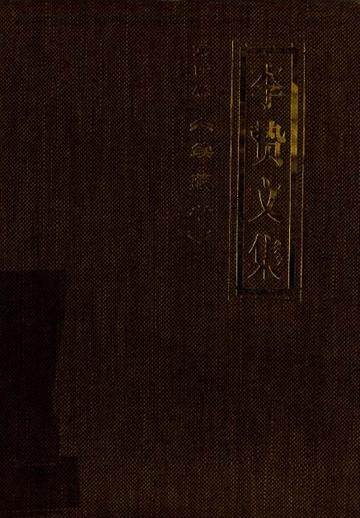
This volume is a continuation of the collection. The first volume is "Burning Books" and "Continued Burning Books". Li Zhi's important works. "Book Burning" consists of six volumes, including letters, miscellaneous narratives, historical treatises, poems, etc. It was first published in the eighteenth year of Wanli (1590), and was later banned and destroyed. The "Burning Book" circulated was re-edited and published by later generations. "Continued Burning Books" consists of 5 volumes. It was edited by Li Zhi's disciple Wang Bencuo after his death and published in the 46th year of Wanli (1618). The content is not as important as "Book Burning", but it is also an important material for studying Li Zhi's thoughts. The second volume is "Chutan Collection". It is a work in which Li Zhi reclassified and edited the materials in the two books "Shishuoxinyu" (written by Liu Yiqing in the Southern Song Dynasty) and "Jiao Shi Leilin" (written by Jiao Hong in the Ming Dynasty), and elaborated his own thoughts through marking and commenting. Li Zhi (1527-1602), a Chinese thinker in the late Ming Dynasty. He was named Zhuowu, also known as Hongfu, and also known as Wenling Jushi, Baiquan Jushi, etc. A native of Jinjiang, Quanzhou (now part of Fujian). His original surname was Lin, and his given name was Zai Zhi. After winning the imperial examination in the 31st year of Jiajing reign (1552), he changed his surname to Li. Hui nationality, believe in Islam. His family has been a wealthy businessman for generations, but his family's fortunes gradually declined during his grandfather's generation. In the 35th year of Jiajing's reign, he was appointed as the magistrate of Gongcheng (now Huixian, Henan). In the 39th year of Jiajing, he was appointed as the doctor of the Imperial College of Nanjing. In the 43rd year of Jiajing, he was re-appointed as the doctor of the Imperial College of Beijing. While he was an official, he witnessed the corruption and incompetence of the court and officials, and often had disputes with his superiors. He experienced the pain of Japanese pirate invasion, famine and poverty, and saw the difficulties in the budding development of capitalism. Driven by the emerging citizen movement, he hoped to find a "Tao" different from the Neo-Confucianism of the Song and Ming Dynasties. He had been exposed to Wang Shouren's teachings and studied Buddhism. After returning to seclusion, he mainly engaged in research, lectures and writings. In 1588 and 1590, "Chutan Collection" and "Burning Books" were published. The book sharply exposed the hypocrisy and selfishness of Taoists, who were attacked and persecuted by Geng Dingxiang and others. In 1599, "Collection of Books" came out, and he was further persecuted. In 1602, he was imprisoned for "daring to advocate chaos, deceiving the world and falsely accusing the people". He committed suicide in the same year. His works have been banned and burned many times, but they continue to be circulated in the world.