The Impassable 38th Parallel, the Inescapable Fate
· Why did Baek Sun-yup, once an ardent worshipper of Kim Il-sung, pledge allegiance to Syngman Rhee?
· Why did the "God of War," MacArthur, leave the stage of history in such disgrace?
· How did Matthew Ridgway lead from the front while directing operations on the Korean battlefield?
· How did Syngman Rhee struggle desperately to hold on to power in his later years?
Decades after the Korean War ended, the 38th Parallel remains shrouded in smoke. As one of the main parties to the war, how do South Koreans view this chapter of history as they face the unbearable pain of their fate?
The Korean War not only led directly to the division of the Korean Peninsula into two countries, but also, with the involvement of major powers such as China, the United States, and the Soviet Union, quietly shifted who took center stage in the fighting. Though more than 70 years have passed, in the collective memory of modern Chinese people, China seems to have been the leading actor in this war. But is the truth of the Korean War really as we understand it?
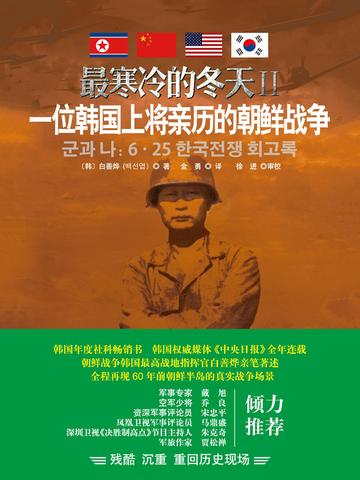
Escaping death in the Battle of the Naktong River, the euphoria of victory at the Battle of Masan, the triumphant entry into Pyongyang, the despair and helplessness of defeat at Seoul, the harsh reality of the armistice talks, and the ambition of building the South Korean army... As a South Korean army general who took part in the Korean War from beginning to end and in the postwar reconstruction, how do Koreans interpret this war with no victors? The South Korean general Baek Sun-yup offers the most authoritative answer in this memoir, 60 years in the making.
Bai Shanye concluded that Han Jun had three major shortcomings. The first is the lack of necessary military training, the second is the lack of equipment, and the third is the lack of battlefield command capabilities.
Seeing another side of the Korean War gives me a more comprehensive understanding of the war. I have experienced more realistic war scenes and the real combat process recalled in the book. I really want to keep reading!
You can learn about the War to Resist U. S. Aggression and Aid Korea from South Korean generals. But there is not much description of actual combat conditions during the war.
It's a good reference material.
Let readers watch it and feel it is real. Retired old workers.
Very good, I gained knowledge. The Korean War is very different from the perspective of a South Korean general.