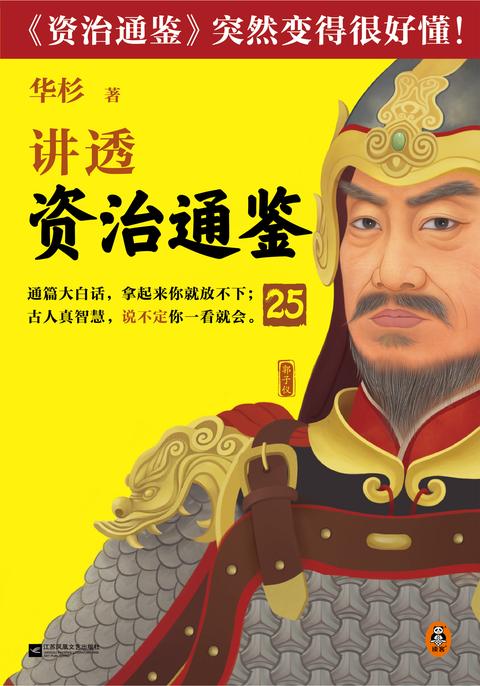
To be a boss, you must learn to put yourself aside. A bedside book for emperors of old and a practical guide for managers today! Hua Shan's latest work makes Zizhi Tongjian suddenly easy to understand!
Zizhi Tongjian covers the period from the Warring States era to the Five Dynasties and Ten Kingdoms. It vividly brings to life the people and stories of 1,362 years across 16 dynasties, making it a vast repository of China's political and cultural heritage, a “big data archive” and a “casebook.”
This is the 25th volume in the series Hua Shan Explains Zizhi Tongjian. It mainly recounts nearly thirty years of history, from the reign of Emperor Suzong to that of Emperor Dezong, following the outbreak of the An Lushan Rebellion. In the spring of the second year of Baoying, the An Lushan Rebellion ended after seven years and two months. To win over the surrendered generals of Hebei, the Tang court appointed Zhang Zhongzhi as military governor of Chengde and bestowed on him the name Li Baochen; appointed Tian Chengsi as defense commissioner of Weizhou; and appointed Li Huaixian as military governor of Youzhou Lulong. From then on, the Hebei military governors grew arrogant and impossible to control. In the first year of Jianzhong, Dezong adopted Yang Yan's proposal and began implementing the Two-Tax Law. After ascending the throne, Dezong tried to curb the power of the regional governors, provoking their resentment. In the second year of Jianzhong, the Fengtian Crisis erupted, and Dezong fled to Fengtian.
Open this book to discover, amid the Tang dynasty's patchwork of military governors, why bosses so often fail to understand what's happening below them!





This book is rich in content, recounting history after the An Lushan Rebellion, as well as the politics and culture of the Tang Dynasty. The characters are vividly portrayed; Liu Zhan's bravery and decisiveness, and Tian Shenggong's wisdom and leadership, all left a deep impression on me.