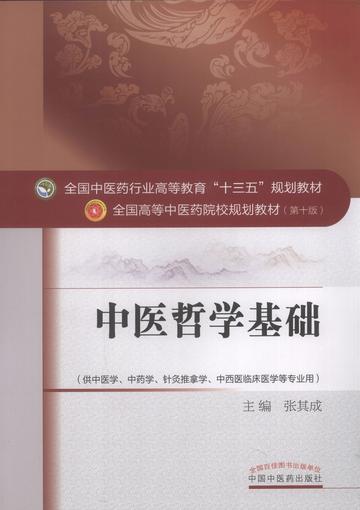
This book is one of the series of textbooks for the "13th Five-Year Plan" for higher education in the traditional Chinese medicine industry. It is based on the purpose of compiling the "13th Five-Year Plan" textbook for higher education in the traditional Chinese medicine industry. It is committed to the needs of talent cultivation in traditional Chinese medicine colleges and universities. It takes dialectical materialism and historical materialism as the guiding ideology, and is scientific, advanced, inspiring, and practical. The writing principles strive to objectively explain the cultural origins, philosophical concepts, ways of thinking and historical development of traditional Chinese medicine, and strive to reflect the latest results and the highest level of current philosophical research on traditional Chinese medicine. The book is divided into six chapters: Chapter 1 Introduction, Chapter 2 Chinese Philosophy and Philosophy of Traditional Chinese Medicine, Chapter 3 Origin of Traditional Chinese Medicine Philosophy, Chapter 4 Basic Category of Traditional Chinese Medicine Philosophy, Chapter 5 View of Life in Traditional Chinese Medicine Philosophy, and Chapter 6 Thinking Methods of Traditional Chinese Medicine Philosophy, for the use of graduate students in colleges and universities of Traditional Chinese Medicine. About the author: Zhang Qicheng, male, is a professor at Beijing University of Chinese Medicine and a doctoral supervisor in the field of Chinese medical history and literature. He has successively served as secretary-general of the Traditional Chinese Medicine Culture Research Center, director of the library, dean of the School of Management, and member of the school's academic committee. He is the editor-in-chief of textbooks such as "Introduction to Traditional Chinese Culture", "Traditional Chinese Culture", "Basics of Traditional Chinese Medicine Philosophy", and "Ancient Medical Texts", and has published monographs such as "Yixue and Traditional Chinese Medicine", "The Trunks of Yidao", and "Exploration of Yitu". He has successively served as chairman of the Traditional Chinese Medicine Culture Branch of the Chinese Society of Traditional Chinese Medicine, chairman of the Yixue and Science Committee of the Chinese Dialectics of Nature Research Society, vice president of the Traditional Chinese Medicine Philosophy Branch of the Chinese Society for the History of Philosophy, vice president of the International Yixue Federation, executive director of the Chinese Laozi Taoist Culture Research Association, and executive director of the Chinese Zhouyi Research Association.
Reader comments
This book is very good! It systematically introduced the basic knowledge of traditional Chinese medicine philosophy and gave me a deeper understanding of the theory of traditional Chinese medicine. The content in the book is both scientific and practical, and is very helpful to our graduate students. Moreover, I think the author, Professor Zhang Qicheng, is very powerful. He explains the complex philosophy of traditional Chinese medicine very clearly and makes it easy for people to understand. I especially like the part about the philosophical thinking methods of traditional Chinese medicine in the book, which gives me a new way of thinking in clinical practice. All in all, this is a good book worth recommending!

This book is very good! It systematically introduced the basic knowledge of traditional Chinese medicine philosophy and gave me a deeper understanding of the theory of traditional Chinese medicine. The content in the book is both scientific and practical, and is very helpful to our graduate students. Moreover, I think the author, Professor Zhang Qicheng, is very powerful. He explains the complex philosophy of traditional Chinese medicine very clearly and makes it easy for people to understand. I especially like the part about the philosophical thinking methods of traditional Chinese medicine in the book, which gives me a new way of thinking in clinical practice. All in all, this is a good book worth recommending!