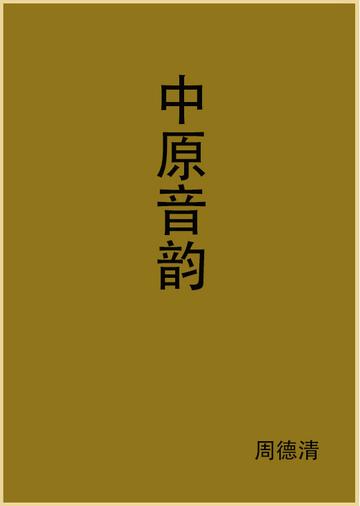
A monograph on the phonology of Northern music. Written by Zhou Deqing of Yuan Dynasty. The first part of the book is a rhyme chart, which is based on the rhyme used in the actual northern phonetic pronunciation (one is said to be Dadu pronunciation, another is said to be Luoyang pronunciation), and is divided into 19 parts. The lower characters of each department are divided into four categories: Yinping, Yangping, Shangsheng and Qusheng. It is the earliest rhyme book of Northern Opera, and later rhyme books of Northern Opera and even Southern Opera, as well as actors' singing and correct pronunciation of words, are all based on this. The latter part is "Examples of Composition of Right Speech". The author emphasizes that rhythm is very important, and makes a special discussion on the pronunciation, word usage, rhythm, and head of Yuan music. The original book was written in the first year of Taiding in the Yuan Dynasty (1324), with a preface by Zhou. There was a printed version at the end of the Yuan Dynasty, but it is not handed down now. The earliest extant edition is the Ne'an edition dated to the sixth year of Ming Zhengtong (1441), which is collected by the Institute of Literature of the Chinese Academy of Social Sciences and used as a copy by Zhonghua Book Company. There are many copies in existence, and the most popular one is the "Collection of Chinese Classical Opera Treatises". Ren Erbei, a recent scholar, published "Ten Methods of Writing Lyrics for the Phonology of the Central Plains", which was included in "Sanqu Congkan".
Reader comments
This book is extremely valuable for the study of phonology and drama composition. It systematically organized the phonological rules of Northern Opera and gave me a deeper understanding of ancient phonology. Especially when I saw the part about "equal division of yin and yang, into three tones", I was reminded of the changes in pronunciation of modern Chinese, and felt that the evolution of language is really wonderful. Moreover, the book also mentioned the influence of dialects on phonology, which reminded me of some unique pronunciations in my hometown, which was very interesting. All in all, this is a great book worth reading!
This book is extremely valuable for the study of phonology and drama composition. It systematically organized the phonological rules of Northern Opera and gave me a deeper understanding of ancient phonology. Especially when I saw the part about "equal division of yin and yang, into three tones", I was reminded of the changes in pronunciation of modern Chinese, and felt that the evolution of language is really wonderful. Moreover, the book also mentioned the influence of dialects on phonology, which reminded me of some unique pronunciations in my hometown, which was very interesting. All in all, this is a great book worth reading!