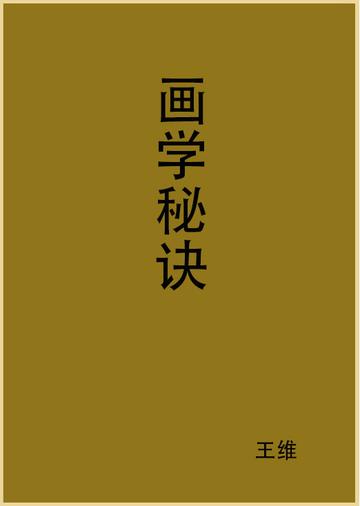
The old title was written by Wang Wei of Tang Dynasty. Wei (701-760), whose courtesy name was Mojie, was originally from Qi County. He later moved to Puzhou (now Yongji) with his father, so he was a native of Hedong. He was a Jinshi in Kaiyuan, and he was forced to take a fake position during the "An-Shi Rebellion". He later moved to the left to become the prince Zhongyun, and finally became the minister of the book Youcheng. In his later life, he was called the king Youcheng. Wang Wei was proficient in poetry, calligraphy, and painting, and was also proficient in music. His poems were famous for landscapes. There were paintings in his poems, and poems in his paintings. In his later years, he was obsessed with Buddhism. Wang Wei was famous among Kaiyuan and Tianbao for his poetry, and his calligraphy and paintings were all excellent, making him one of the celebrities at that time. It is said that Wang Wei's "Landscape Theory" and "Landscape Jue" are all painter's formulas, but this chapter is not found in the "Wang Wei Collection" compiled by Wang Jin. Moreover, the book was first recorded in Jiao Cuo's "National History Classics and Records" in the Ming Dynasty. The words are written in parallel style, and the syntax format is similar to the Southern Song Dynasty people's language. Therefore, some people are suspicious, thinking that a later generation faked the book based on Wang Wei's name, and the Ming people included it in a rough way without careful examination. "Sikuquanshu General Catalog" only retains its title and introduces it.
Reader comments
In particular, the sentence "A tall mountain can divide a tree and an inch of a horse can divide a person" perfectly expresses the importance of proportion in painting. Moreover, the descriptions of various scenery in the book are also very delicate, such as "There are no rocks in the distant mountains, faintly like eyebrows; There are no waves in the distant water, and the heights are as high as the clouds." The picture appears in front of you at once. However, some people suspect that this is a fake, but the painting skills are still worth learning~




In particular, the sentence "A tall mountain can divide a tree and an inch of a horse can divide a person" perfectly expresses the importance of proportion in painting. Moreover, the descriptions of various scenery in the book are also very delicate, such as "There are no rocks in the distant mountains, faintly like eyebrows; There are no waves in the distant water, and the heights are as high as the clouds." The picture appears in front of you at once. However, some people suspect that this is a fake, but the painting skills are still worth learning~
That makes sense, try drawing.