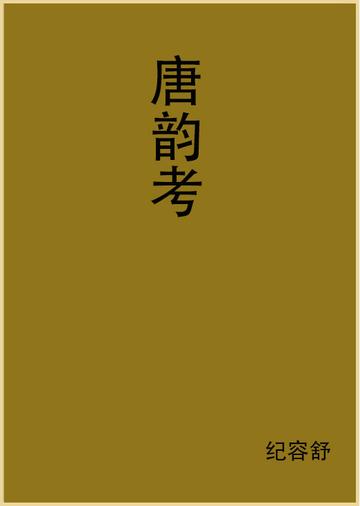
Five volumes. Written by Rong Shu in the Qing Dynasty. Ji Rongshu, whose courtesy name was Chisou and nicknamed Zhuya, was from Xianxian County, Zhili Province (now Xianxian County, Hebei Province). In the fifty-second year of Kangxi (1713), he was promoted to the prefect of Yao'an Prefecture. Tongyin rhythm, especially ancient rhyme. He is also the author of "New Odes of Yutai" and "Du Lvshu". Sun Hui's "Tang Yun" has been lost for a long time. In the third year of Yongxi reign of the Northern Song Dynasty (986), Xu Xuan edited Xu Shen's "Shuowen". At that time, "Guang Yun" had not yet been completed. Ji believes that in the Fanqie method, the upper characters must have the same letters and the lower characters must have the same rhyme; in the case of Quaiqie, only the upper characters have different letters but the lower characters have no change in rhyme. Therefore, he collected and compiled the fanqie contained in "Shuowen", compared and analyzed the characters below, and classified them into their own categories to complete this book. The divisions of "Tang Yun" and "Guang Yun" summarized by Ji are the same, but the two books included are slightly different: some include "Tang Yun" but not "Guang Yun"; some have "Tang Yun" in one part and "Guang Yun" in that part; some include both "Tang Yun" and "Guang Yun" only save one of them, etc. "Summary of the General Catalog of Sikuquanshu" says: "Its inferences and examinations are well-organized. Examples of divisions and combinations in "Tang Yun" and traces of changes and mergers in "Song Yun" can be obtained from this, and it is also a reference for elementary school students." "Yuemantang Reading Notes" says: "Ji's study of "Shuowen" was actually not advanced, so there are two major errors in his work: the letters of a character are not in order, and some letters are even missing; the Xu family's book is not different from the new appendix, but it is just a collection of it." This book has the Shoushan Pavilion version and the "Jifu Congshu" version. The annotations of the publication were edited by Qian Xizhuo, and forty-four items were added to the missing sound. The missing words were cut out in 111 to 15, and the errors were omitted, and the notes were appended to make it more precise. Li Ciming said that this was actually the work of Zhang Wenhu, who was from Nanhui (now Nanhui County, Shanghai).
Reader comments
This book "Tang Yun Kao" is really amazing! Through the study of Fanqie in "Shuowen", Ji Rongshu allows us to understand the difference between "Tang Yun" and "Guang Yun". Just like my cousin who studies Chinese and is particularly obsessed with studying ancient pronunciation, this book will definitely be of great help to her. And I especially like the author's rigorous academic attitude. If I can have this seriousness when looking for a job, I will definitely find a good job!
This book "Tang Yun Kao" is really amazing! Through the study of Fanqie in "Shuowen", Ji Rongshu allows us to understand the difference between "Tang Yun" and "Guang Yun". Just like my cousin who studies Chinese and is particularly obsessed with studying ancient pronunciation, this book will definitely be of great help to her. And I especially like the author's rigorous academic attitude. If I can have this seriousness when looking for a job, I will definitely find a good job!